Toughened glass cut to size
Cut, processed and toughened to your sizes in Wembley — with every hole and cut-out made before it goes into the furnace.
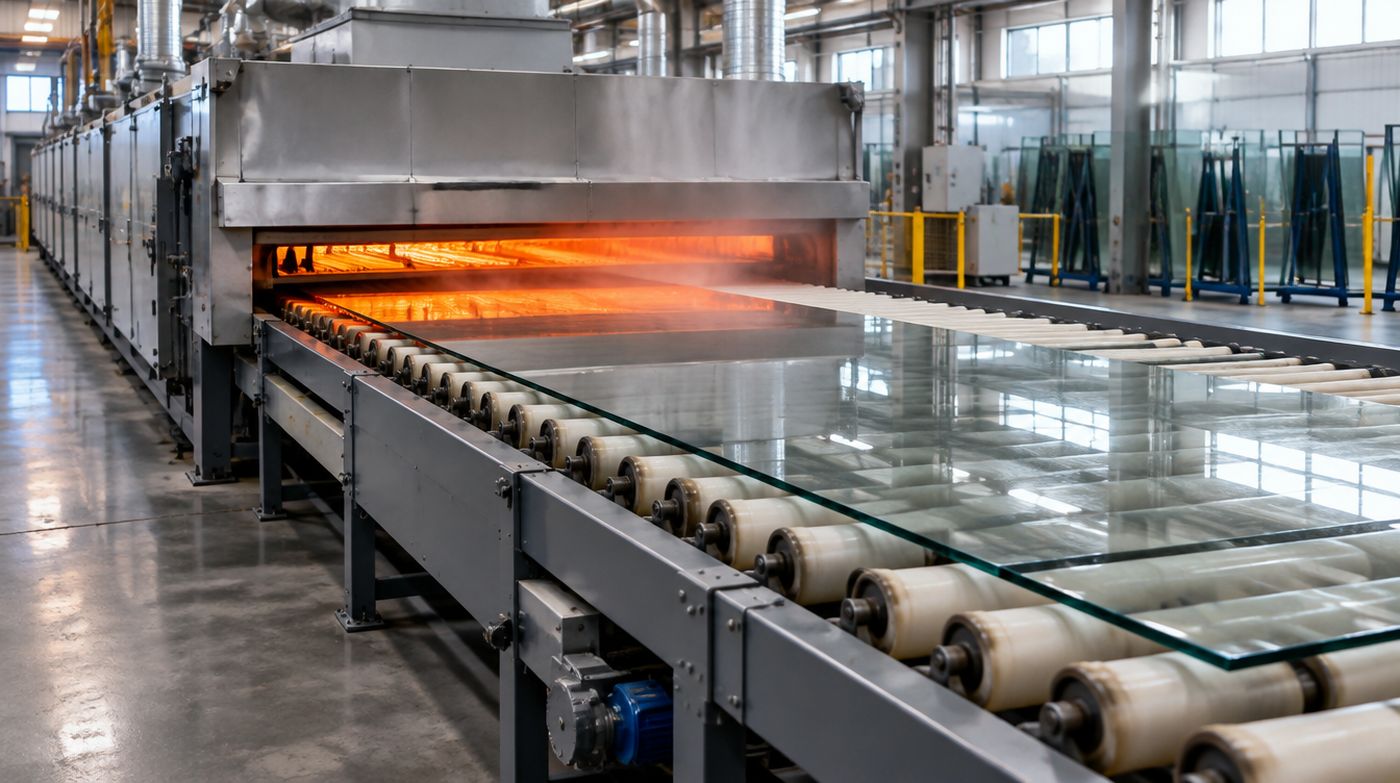
Toughened glass cut to size, processed in our own Wembley workshop
We supply toughened glass cut to size from our own cutting and processing workshop at 6 Atlas Road in Wembley, which means your sizes go onto a cutting table rather than out to a third party. Clear float, low-iron, body-tinted, solar control and most obscure patterns, in the usual thicknesses, with edgework, holes, notches and radius corners all worked before the glass is heat treated. Every piece is bespoke glass cut to size from your figures, for trade collection from HA9 or delivery across London.
Toughened glass is ordinary float glass that has been heated close to its softening point and then cooled quickly and evenly. That puts the two surfaces into compression and the core into tension, and the locked-in stress is what makes the pane several times stronger in bending than the same thickness of untreated glass. It is also why it fails the way it does, dicing into small blunt fragments rather than long shards. The standard is BS EN 12150, and properly made toughened glass carries a permanent mark saying so.
Why we need your final sizes before anything goes in the furnace
A toughened pane is a balanced system of stresses. Score it, nick an edge or drill it after treatment and that balance is released, and the sheet comes apart on the bench in front of you. This is not a workshop preference or a liability dodge. It is why the processing order is fixed and never varies: cut, work the edges, drill and notch, check, then toughen.
Which means everything has to be on the drawing before the furnace, including the things customers treat as details. Hole positions and diameters. A notch for a cable or a pipe. A radius on two corners rather than four. A cut-out for a tap. If it is missed, the remedy is a new pane, not a modification, and that is the whole argument for spending an extra ten minutes on the order.
The furnace also has consequences for what you receive, and a decent supplier tells you about them in advance rather than waiting for the complaint. Glass travels through on rollers while it is soft, which leaves a faint regular ripple known as roller wave, visible in reflection when you look along the pane at a shallow angle. Large thin panes can also pick up a slight bow. Neither is a defect within the tolerances of the standard. What matters is knowing where it shows. On a table top, a long dark splashback or a shopfront we orient the roller wave so it runs the least obvious way, and if you have a pane where flatness is critical, say so when you order and we will talk about thickness and glass type before we cut.
Cut sizes carry a tolerance as well, and it is wider on toughened than on plain cut float, because heat treatment moves glass very slightly. If you are working into a tight metal frame or a channel, give us the gap you actually have rather than only the size you would like, and we will work out the cut size with you.
Where the regulations say you have to use safety glass
Approved Document K sets out critical locations: glazing in doors and in the panels beside them, and glazing low down in walls, where somebody can walk into it. Glass in those positions must break safely, or be small enough, or be permanently protected. In practice that means toughened to BS EN 12150 or laminated to BS EN 14449, with impact performance to BS 6206 Class A or the equivalent class in BS EN 12600, and a permanent mark so that anybody inspecting it can see what it is.
Glass forming part of a barrier is a further step again. Juliet balconies, balustrades and infill panels where there is a drop are loaded elements, covered by BS 6180, so the thickness and the make-up follow the loading and the fixing method rather than a feeling. For most barrier work we will steer you towards toughened laminated rather than plain toughened, on the simple ground that a barrier which dices and disappears has stopped being a barrier.
There is also a great deal of glass that does not legally need toughening and that people pay to have toughened anyway. A small cabinet door at chest height. A picture frame. A shelf inside a cupboard. If that is your job we will say plain float is fine and charge you less for it. Where we will not move is the critical locations, and you should be wary of any merchant who will.
Which thickness for which job
Thickness follows span, loading, edge support and the consequence of deflection. Here is roughly how the common thicknesses earn their keep.
- Four millimetre toughened: small door panes, cabinet fronts and light infills, well supported on all four edges
- Six millimetre toughened: the workhorse. Splashbacks, most shelves on short spans, replacement glass panels in doors and side screens, small table protectors
- Eight millimetre toughened: longer shelves, heavier splashbacks behind a range, larger door panels, framed shower screens
- Ten and twelve millimetre toughened: frameless shower screens, free-standing table tops, long unsupported shelves, partitions, and anything with hinges or patch fittings bolted through it
Hinged and bolted work is the one case where the thickness is decided for you. Shower hinges, patch fittings and door rails are made for a specific glass thickness and a specific hole and cut-out pattern, and they are unforgiving about both. Send us the fitting manufacturer's template, or the fitting itself, and we will work from that rather than from a measurement taken off a photograph.
Edgework, and why it is not only about looks
Glass comes off the cutting table with an edge that is, at a microscopic level, a row of chips and flaws. Four finishes deal with it. An arris is a quick dress of the sharp corner, enough to make a pane safe to handle where the edge will be hidden in a frame. A ground or satin edge is squared and smoothed to a matt finish. A flat polished edge is ground and then polished clear, and that is what you want on anything you can see or touch: shelves, table tops, shower screens, free-standing panels. A bevel is a decorative angled polished band around the face, and it is slower and dearer than all of them.
On toughened glass the edge finish also decides whether the pane survives the process. Chips concentrate stress, which is where heat treatment is most likely to break a pane and where a later failure is most likely to start. That is why exposed pieces get their edges worked as routine here rather than as an upgrade somebody remembers to sell you.
Worth knowing too: toughened glass occasionally fails on its own, days or years after installation, and it is usually traced to a microscopic nickel sulphide inclusion in the original glass that changes volume over time. It is rare, it is not a workmanship fault, and it is one of the better arguments for laminated or toughened laminated in overhead glazing, where a pane letting go is more than an inconvenience.
Holes, notches, radius corners and cut-outs
All of it is possible and all of it has geometry rules, because every hole and every corner is a stress concentration in a sheet that is about to be put under tension.
As a working rule, a hole should not be smaller in diameter than the glass is thick, and it has to keep its distance: in the order of twice the thickness from any edge, twice the thickness from the next hole, and considerably further than that from a corner, which is the worst place on a sheet to put anything. Notches and internal cut-outs need radiused internal corners, never sharp ones, for the same reason a crack always starts at a point. Where your fitting demands something tighter than those rules allow, tell us early. Sometimes the answer is a thicker pane, sometimes it is laminated rather than toughened, and sometimes it is moving a fixing fifteen millimetres and nobody ever noticing.
Radius corners on shelves and table tops are a different matter, about comfort and safety rather than geometry. Give us the radius in millimetres and say which corners, or hand us a template and we will follow it.
Obscure glass, and how much privacy you are actually buying
Obscure or patterned glass is rolled with a texture on one face, and manufacturers rate each pattern for obscuration, generally on a scale running from barely blurred at the bottom to no recognisable shape at all at the top. Fine satin and acid-etched finishes sit near the top of that scale and give an even, modern, frosted appearance with no pattern to date it. The heavier textures, the reeded, stippled, hammered and leaded-light patterns, give strong obscuration with far more character, and they suit a period front door better than a flat frost ever will.
Two practical points. Privacy depends on distance and light as well as on the pattern, so a bathroom window two metres from a neighbour's blank wall needs less obscuration than a ground floor door opening onto a shared path. And patterned glass has a face side: the texture faces into the bathroom if you want it easy to clean, or outwards for the look, and it has to be stated on the order because once the pane is toughened you cannot turn it over. Most common patterns can be toughened. A few cannot, and we will tell you which when you name the pattern.
Toughened or laminated? The honest comparison
Laminated glass cut to size is two or more panes bonded to a plastic interlayer under heat and pressure, made to BS EN 14449. It is a safety glass like toughened, but it fails differently. It cracks and stays in the frame, held together by the interlayer.
Laminated wins in four places. Overhead, because a broken pane that stays put does not land on anybody underneath it. Security, because the interlayer resists repeated blows rather than giving way at the first one, and it is the usual route to satisfying Approved Document Q on new dwellings. Acoustics, because an acoustic interlayer damps sound in a way a single monolithic pane of the same weight does not, which matters on the main roads and under the approach paths across west London. And ultraviolet, because the interlayer screens most of it, which is worth having over artwork, fabric or a timber floor.
The fifth advantage is the one trade customers care about most: laminated glass can be cut, and its edges worked, after it has been made. On a fit-out where sizes move once the stud work goes in, that flexibility is worth real money. Toughened, for its part, is stronger in impact, lighter for the same job, cheaper for an ordinary pane and the right answer most of the time. Tell us the application and we will tell you which, and we will say so plainly if you have been quoted for the wrong one.
Low-iron, tinted and solar control glass
Ordinary float glass contains iron, which reads as a green cast you notice on a cut edge and across any large pale surface. Low-iron glass takes most of it out. It is the right call for a white or pale splashback, a shelf against white tile, a cabinet front over pale stone or the top of a white table, where standard float will look faintly swampy. Against a dark surface nobody will ever see the difference, and we will tell you not to pay for it.
Body-tinted glass carries colour through the full thickness, in the familiar bronzes, greys, greens and privacy near-blacks. It cuts light and glare and the colour never fades, but it does its work by absorbing energy, which is why a tinted pane runs hot and why tinted glass in a sunny position should be toughened rather than plain.
Solar control glass works mainly through a coating that reflects part of the sun's heat before it gets inside, and the two numbers worth asking about are the light transmission and the solar factor, which is the proportion of solar energy that gets through the glass. The blunt version is this: dropping one pane of solar control glass into an overheating conservatory roof will help slightly and will not solve the problem. Heat is arriving through every pane, and a coated single pane cannot do what a properly specified sealed unit with the coating on the correct surface does. We make sealed units in the same workshop, so if that is your real problem, ask about the unit rather than the pane.
Mirror and toughening do not mix
People ask for toughened mirror often enough that it is worth saying plainly: the silvering and backing on a mirror will not survive a toughening furnace. Mirror cut to size is supplied as mirror, with the edges worked and any holes drilled as part of the order. Where a mirror has to be safe when broken, the answer is a safety backing film bonded to the rear, which holds the fragments in place. Specify it for low-level mirror, mirrored wardrobe doors, stairwells and anywhere above a hard floor.
Handling, transporting and storing cut glass
Trade customers collect from Wembley HA9, Monday to Friday, eight until five, and most do. If you are collecting, bring something to pad and separate the pieces, and plan to carry the glass on edge rather than flat. Glass is strong in compression along its edge and weak in bending across its face, so a sheet lying flat on a van floor flexes over every pothole and speed hump between here and the job. Standing on edge, leaning slightly against a bulkhead or an A-frame, with blankets or polystyrene between the pieces and a strap tensioned onto a flat edge rather than a corner, it travels perfectly well.
Store it the same way on site: on edge, up off the floor on timber battens, leaning at a slight angle against a solid wall, somewhere nothing is going to be stacked against it and nobody is going to reverse a barrow into it. Keep cut edges dry until the glass is fitted, and do not leave panes stacked tightly face to face in direct sun with moisture trapped between them. Carry edges, not corners. If a pane is beyond a comfortable one-person lift, wait for the second pair of hands rather than trying it on the stairs.
Ring 020 4634 6045 with your cutting list, or send it over with sizes, types, thicknesses, edgework and a note of whether you are collecting or want it delivered. If anything on the list looks like the wrong glass for the job, we will say so before we cut it, not after.
FAQ
Questions we get asked
How much does glass cut to size cost?
Price depends on the glass type, thickness, area and edgework, and toughening roughly doubles the glass cost. A small float shelf is a few pounds; a large toughened low-iron table top with polished edges and radius corners is a different order of figure. Send sizes and what it is for and we will price it properly — the application often changes what you actually need.
Can you toughen glass I already have?
No, and nobody can. Toughening is a heat treatment applied to glass that has already been cut to its final size with every hole and cut-out in it. An existing pane cannot be put through the furnace and come out as a toughened version of itself. If you need toughened glass, it is made from scratch to your sizes.
Do I need toughened glass or will float do?
It depends on the position, and in several of them it is a legal requirement rather than a preference. Approved Document K requires safety glass in doors, in side panels within 300mm of a door, and in glazing below 800mm from the floor. Beyond the regulations, anything you lean on, put weight on or might walk into — shelves, table tops, low windows — should be toughened. For a picture frame or a cabinet door, float is fine.
How should I measure?
Width first, then height, in millimetres, and measure the opening in three places because frames are rarely square. Tell us whether the figure you are giving is the size of the glass you want or the size of the hole it has to go into — that single ambiguity causes more wrong panes than anything else. If you are unsure, we will come and measure.
Can I collect, or do you deliver?
Both. Collection is from our unit at 6 Atlas Road, Wembley HA9 0JH during opening hours — call first so your glass is ready and someone is free to load it. We deliver across London. Glass must travel on edge, never flat, and we pack it accordingly; if you are collecting, bring something to stand it in.
Do you supply the trade?
Yes. We cut and process for builders, joiners, shopfitters, kitchen fitters and other glaziers, with trade pricing and accounts available. Send a cutting list and we will come back with a price and a lead time.
Send us your sizes
Give us the glass type, thickness and sizes in millimetres, or a cutting list. We will come back with a price and a lead time.