Glass shelves cut to size: span, load and the brackets
Nearly every sagging or broken glass shelf is a span problem rather than a weight problem. Order glass shelves cut to size with the span and the bracket positions in mind and the shelf will outlast the wall it is fixed to.
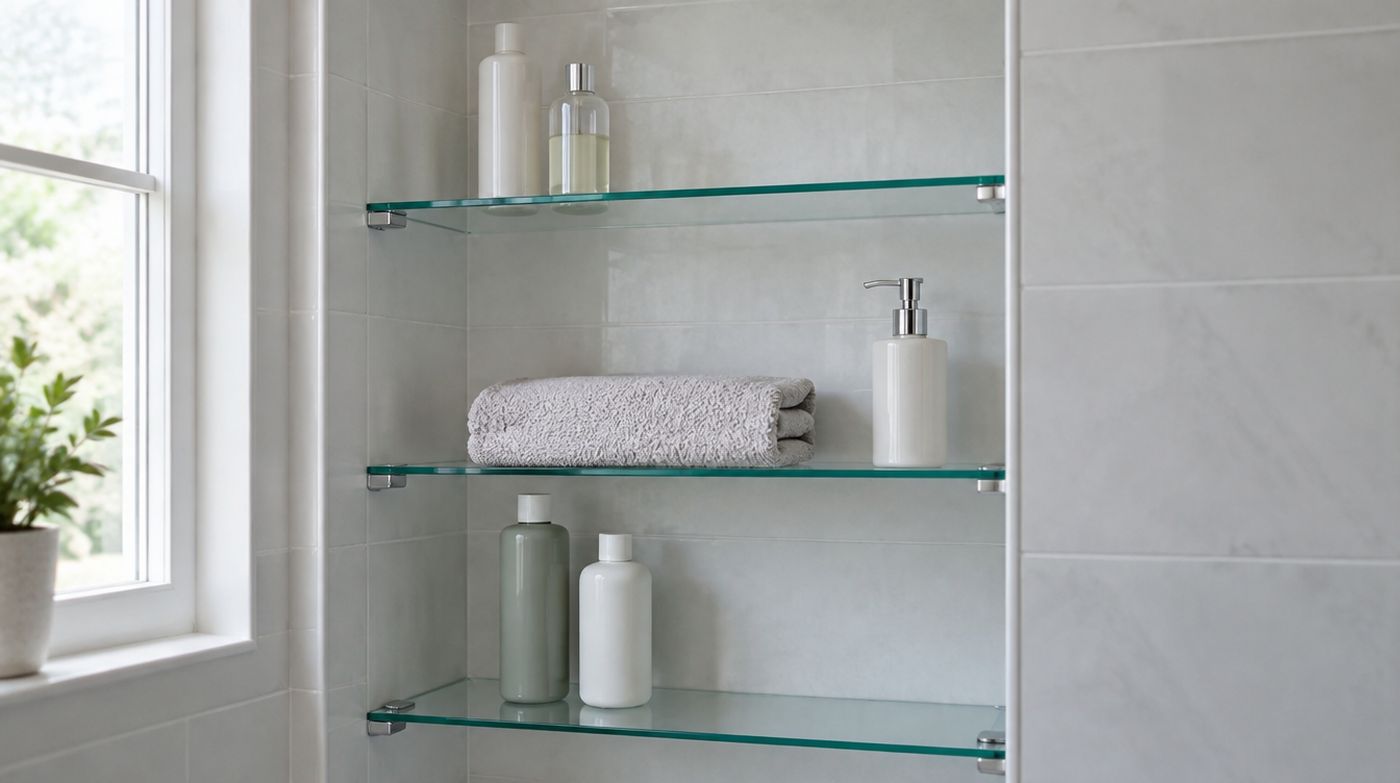
Glass shelves cut to size: why span matters more than weight
When people order glass shelves cut to size they tend to ask whether the glass will take the weight. That is the wrong question in isolation. A shelf fails because of how far it has to reach between supports, and the relationship is not linear. Double the unsupported span and the deflection under the same load goes up by roughly eight times, while the stress in the glass roughly quadruples. Double the thickness and the deflection falls by about eight times.
That is the whole engineering of a glass shelf in two sentences. Bring the supports closer together, or make the glass thicker, and everything improves dramatically. Everything else is detail.
So the first figure to establish is not what the shelf will hold. It is the clear distance between the brackets, or between the two walls if the shelf is going into an alcove. For a free span on brackets in the middle of a wall, measure bracket centre to bracket centre and treat the bits beyond the brackets as overhang, which carries its own problem.
How thickness and span work together
As a working guide for domestic loads, and assuming toughened glass and brackets that grip properly: 6mm is sensible up to around 500mm of span for light duty, ornaments and bathroom bottles. 8mm comfortably handles 600mm to 700mm. 10mm is the thickness for 800mm to 900mm and is the one we fit most often. 12mm takes you to around a metre, and beyond that you want either a thicker glass again or an extra bracket in the middle.
Shorten those figures if the shelf is going to carry books, spirits bottles, a stack of plates or anything else with real mass, and shorten them again if the load will sit in the middle rather than spread evenly. Lengthen them slightly for a display shelf holding photographs.
Here is the honest version, though. For most alcove and bathroom shelves, the right answer is 10mm toughened, polished all round, and you can stop thinking about it. The money you might save going to 8mm on a 700mm shelf is a few pounds, and the difference in how solid it feels when you put something down on it is immediate. This is one of the very few places on this site where we will tell you to buy the thicker option without arguing.
Deflection, and why a shelf that is strong can still feel wrong
A shelf can be nowhere near breaking and still be unacceptable, because you can see it bowing. Glass is perfectly elastic up to the point it fails, so it does not deform permanently or warn you by sagging the way a timber shelf does. It simply bends under load, springs back when you remove it, and looks alarming while loaded.
Visible deflection is the practical limit on a glass shelf long before strength is. If you load a long 6mm shelf you will see a gentle curve in the reflections along it, and once you have seen it you will not stop seeing it. This is why we push people towards shorter spans rather than clever glass.
It also explains an oddity people notice. A thick shelf on wide-set brackets can feel less secure than a thinner shelf on close-set ones. The thin shelf is not stronger. It is just spanning less.
Brackets, and what they actually have to do
A bracket on a glass shelf has two jobs. It has to support the glass over an area rather than at a point, and it has to not transmit a hard local load into the pane. Glass does not mind compression spread over a surface. It minds being pinched.
So the bracket face that touches the glass should be flat, should be at least as deep as a sensible proportion of the shelf depth, and should have a rubber, nylon or felt gasket. Any bracket where a metal screw or a sharp metal lip bears directly on the glass will eventually chip it, and a chipped edge on a toughened shelf is the beginning of the end for the pane.
Clamp brackets, which grip the top and bottom faces, give the most rigid result and are what we would use for a long or a heavily loaded shelf. Pin or peg supports that enter drilled holes look the cleanest but need the holes drilled before toughening, so the shelf has to be made for those brackets specifically. Simple L brackets under the glass with a soft pad are perfectly adequate for a light shelf and cost very little.
Set the brackets in from the ends rather than right at the ends. A small overhang each side looks better and reduces the effective span at the same time, which is a free improvement. Too much overhang and you are back to a cantilever that someone will lean on.
Alcove shelves, and why the wall is the hard part
Alcove shelving either side of a chimney breast is the single commonest glass shelf job in London, and in a Victorian or Edwardian house the glass is never the difficult bit. The walls are.
Expect the two side walls to be out of parallel, out of plumb and uneven in the plaster. Three to five millimetres of difference between the alcove width at the front and at the back is normal, and more than that is common where a chimney breast has been replastered. Measure the width at the front, the middle and the back, at the height each shelf will sit, and give us the smallest figure. Then let us take a clearance off that.
A shelf cut to the exact widest dimension will not go in. A shelf cut to the narrowest dimension with 3mm or 4mm off will go in, and the small gaps at the side disappear behind the bracket. If you want the glass to touch both walls with no gap, that is a scribed panel and a template job, and it is covered on our bespoke glass cut to size page. For an alcove shelf it is almost never worth it.
The fixings matter more than anything. Old lath and plaster, soft Victorian brick and modern stud partitions all need different anchors, and a 10mm toughened shelf on good brackets with the wrong plugs is a hazard rather than a shelf. If the alcove wall is a stud partition, find the studs and fix to them, or use proper heavy duty cavity fixings rated for the load.
Bathroom shelves and shelves in cabinets
In a bathroom, toughened is not negotiable for anything at waist height or above, because the floor is hard and people are unsteady and sometimes bare-skinned. Polish all four edges, not just the front, because a bathroom shelf gets wiped on all sides and because someone will reach past it. Keep spans short and bracket into something solid behind the tiles rather than into tile adhesive.
Shelves inside a cabinet or display unit are a genuinely different case, and this is where we will talk you out of spending money. If the shelf sits in four supports inside a carcase, nobody can walk into it, fall against it or sit on it, and the span is short. Annealed float at 6mm is honestly fine there, and a lot of cabinet shelves sold as toughened did not need to be. Regulations on safety glass are about critical locations in a building, not about every piece of glass in the house.
The exception is a tall display unit where a shelf is at head height and a child could pull on it, or a shop or office fitting that the public will use. In those positions, toughen it.
What not to buy for a shelf
Low-iron glass is wasted on most shelves, with one genuine exception: a glass shelf shows its edge more than almost any other panel in a house, so if the shelf is at eye level against a pale wall, the faint green line of ordinary float can be noticeable and low-iron earns its money. On a shelf above head height, or in a cabinet, it does not.
Bevelled edges on a shelf are usually a mistake. A bevel takes thickness out of the edge where the brackets grip, it collects dust along the mitre, and on a 10mm shelf it makes the glass look thinner than it is. A flat polished edge is the right finish and the cheaper one.
And do not buy a shelf longer than your wall can support in the hope that the glass will cope. It probably will. The fixings will not.
FAQ
Questions about glass shelves cut to size
How thick should a glass shelf be?
Work from the clear span between supports rather than the total length. For normal domestic loads on toughened glass, 6mm suits spans up to around 500mm for light items, 8mm covers 600mm to 700mm, 10mm handles 800mm to 900mm and is the usual choice, and 12mm takes you to about a metre. Reduce those spans if the shelf will carry books, bottles or plates, or if the load concentrates in the middle. Adding a bracket is always more effective than adding thickness, because halving the span cuts deflection by around eight times.
Do glass shelves need to be toughened?
It depends where the shelf is. Any shelf someone could fall against, walk into or pull down should be toughened, which covers wall-mounted shelving in bathrooms, hallways, bedrooms and living rooms, and anything in a commercial space the public uses. A short shelf sitting on four supports inside a cabinet or display carcase is a different case: nobody can reach it with any force and 6mm annealed float is reasonable there. Plenty of cabinet shelves are sold toughened when they did not need to be, so ask what the position actually requires before paying for it.
How do I measure a glass shelf for an alcove?
Measure the alcove width at the front, the middle and the back, at the height the shelf will sit, because the two walls will not be parallel in most London houses. Three to five millimetres of variation is normal. Take the smallest of those figures and have two or three millimetres of clearance deducted from it, so the shelf will actually drop into position. Tell us whether the figure you give is the alcove or the finished glass, so the clearance is taken off once. The small side gaps end up hidden behind the brackets.
Send us your sizes
Give us the glass type, thickness and sizes in millimetres, or a cutting list. We will come back with a price and a lead time.