Buying from a glass merchant cut to size
Ordering from a glass merchant cut to size is a different transaction from buying anything else in the building trade, because the product does not exist until you have described it. Getting the description right is most of the job.
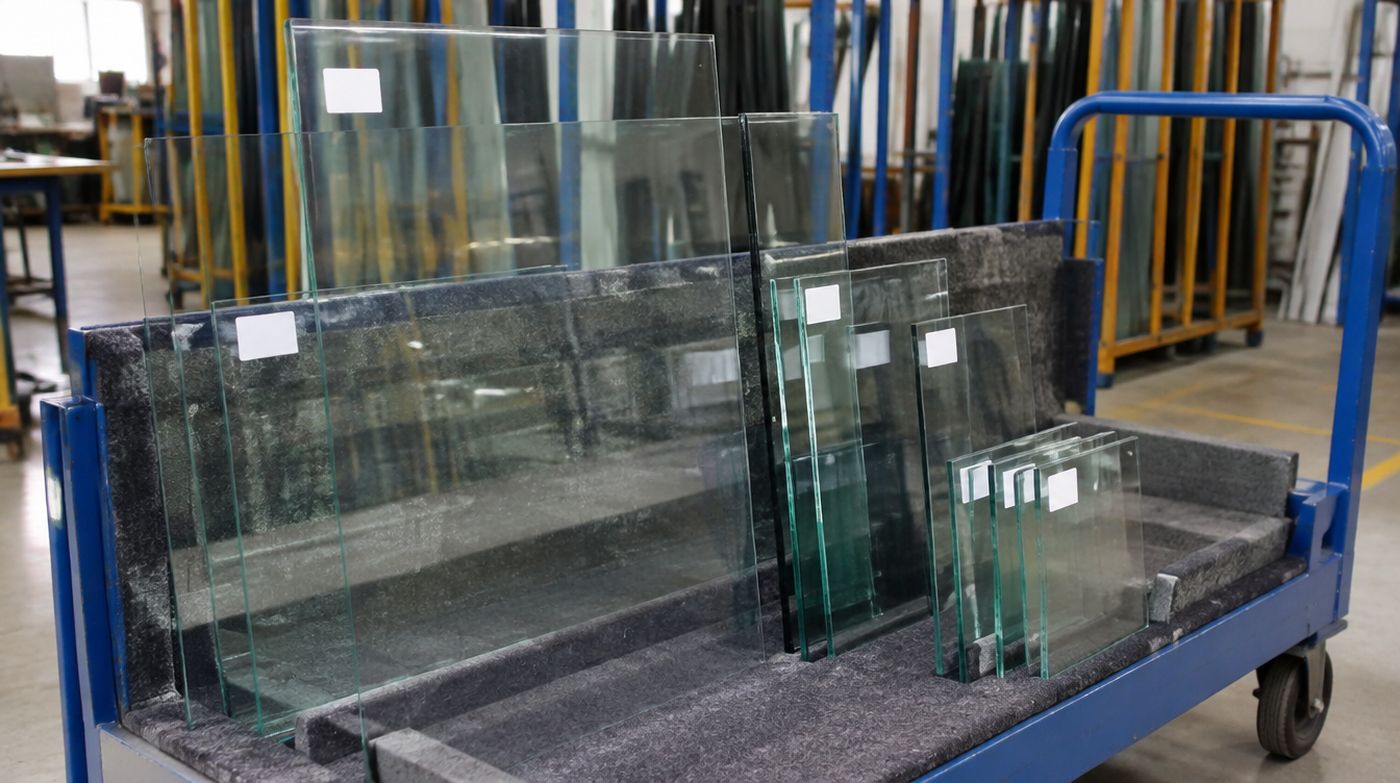
What a glass merchant cut to size actually does with your order
When you hand over a size, somebody has to decide which stock sheet your pane comes out of. That decision is the whole economics of a glass merchant cut to size order, and it explains most of what seems odd about glass pricing. A sheet is a fixed rectangle. Your pane is cut from it, and whatever is left is either useful for the next job or it is waste. A pane whose dimensions happen to divide neatly into a stock sheet is cheap to produce. A pane that is slightly too big to get two out of a sheet effectively costs you the whole sheet.
That is why a 10mm increase in a dimension sometimes makes no difference to the price and sometimes adds a third to it. If a quote looks disproportionate for the size, it is worth asking whether a small change in dimensions would land better on the sheet. A merchant who knows their stock can usually answer that in a few seconds, and on a large panel it can be a real saving. Nobody will volunteer it unless you ask.
Merchant or processor: who is cutting your glass
The words merchant, glazier, cutter and processor get thrown about loosely. The distinction that affects you is whether the glass is cut and finished in the building you are standing in or sent elsewhere.
A traditional glass merchant holds stock sheets and cuts over the counter. Simple rectangles in plain float, usually while you wait. Anything needing a polished edge, a drilled hole, toughening or lamination goes out to a processor, which adds days and a margin. A processor does the cutting and the machining in house and sells both to the trade and, in our case, direct to the public. That is what the Wembley workshop is: the cutting tables, the edging and drilling machines, the toughening furnace and the laminating and sealed unit lines are all on the same site.
For a pane of 4mm clear for a greenhouse, that difference is irrelevant and the nearest counter wins. For a 10mm toughened shelf with polished edges and radius corners, it determines whether you wait two days or two weeks, and whether the person quoting can tell you what radius they can actually hold.
What a merchant keeps in stock, and what gets ordered in
Stock is a commercial decision, and it follows demand. Expect to find clear float in 4mm, 6mm and 10mm as a given, with 3mm and 8mm usually there too. Expect one or two common obscure patterns, mirror in a couple of thicknesses, and 6.4mm clear laminate. Low-iron is increasingly stocked in the popular thicknesses. Toughened in standard shelf and splashback thicknesses may be held as blanks.
What is not routinely on the floor: 2mm picture frame glass in quantity, 12mm and 15mm plate, thick laminates, body tinted glass, fire rated glass, and the great majority of patterned designs. Any of those are a special order, and the honest answer is a lead time rather than a same-day collection.
It is worth asking what is in stock before you settle on a specification. If 6mm is on the floor and 8mm is a week away, and your job works at either, you have just saved a week by asking one question. People specify a thickness from a website and then wait for it unnecessarily.
How to write the order: width first, height second
The glass trade convention is width then height, and the first figure is the horizontal one as the glass will be installed. That sounds obvious until you are ordering a tall narrow panel, at which point writing 300 x 1800 and 1800 x 300 are two very different panes and only one of them fits.
It matters more than it used to, because patterned glass, mirror and anything with a directional finish all have to be cut with the right dimension running the right way. For plain clear float on a square-cut rectangle, the order of the figures makes no practical difference to the pane you get, but it can still change what the person quoting assumes about the job.
Always include units. Write millimetres, and write them as whole numbers. The trade works in millimetres throughout and a figure given in centimetres or in inches has to be converted by somebody, which is where a factor of ten error gets introduced. If you have measured in inches because the frame is Victorian, say so and give the inches rather than converting roughly yourself.
And state whether each figure is the aperture or the finished glass. We say this on every page of this site because it is genuinely the most common cause of a wrong pane, and the responsibility for it is shared between a customer who did not say and a merchant who did not ask.
Pattern direction, and the mistake that ruins a sheet
Rolled patterned glass has a direction. The texture was formed by a roller, so lines, flutes and reeded designs all run one way along the sheet. If you order two panels for the same door and do not say which way the pattern should run, you may get two panels whose pattern runs at ninety degrees to each other. Both are correct to the dimensions. Only one set matches.
So for any patterned or directional glass, add a line saying which way the pattern runs relative to the first dimension. For reeded or fluted glass say whether the flutes should run vertically or horizontally when installed. For any obscure glass, say which face should be the textured one, because an obscure pane fitted with the texture inward behaves differently to clean and feels different to touch.
The same applies to mirror with a bevel or a directional finish, and to any glass with a printed or screen applied pattern. Five extra words on the order prevent a remake that nobody is obliged to pay for.
How cut glass is priced, and what the minimum charge is for
Pricing starts with a square metre rate for the glass type and thickness, then adds the processing: linear metres of edgework, each hole or notch, toughening as a separate operation, and delivery. A minimum charge then overrides all of that on small pieces, because a 200mm square pane consumes almost as much handling, setup and machine time as one twenty times the size.
That minimum is the part people argue with and it is the part that is least arguable. What is worth negotiating is the quantity. If you are paying a minimum charge anyway, find out how much glass that minimum actually covers. You can frequently get three or four small panes for not much more than one, which is why it is sensible to order your greenhouse spares and your cabinet shelves in one go rather than one at a time across a year.
Offcuts are the other thing worth asking about. Merchants and processors accumulate perfectly good remnants, and if your pane can come out of a remnant rather than a new sheet the price can drop noticeably. It only works if your dimensions are flexible and you are willing to take what is there, but for a shelf, a protector top or a cabinet pane it very often is. Ask what is in the offcut rack before you accept a quote off a full sheet.
Trade and retail
We supply both, and the mechanics of trade accounts, credit terms and volume pricing are covered properly on a sister site rather than here. What is relevant on this page is simply what changes about the ordering experience. Trade customers are expected to supply a clean cutting list and to carry the risk on their own figures. Retail customers get more of the specification work done for them, which is why a small retail order and a small trade order are not priced identically.
If you are a builder, joiner or shopfitter ordering regularly, it is worth asking about trade terms on the first substantial order rather than the fifth. If you are a homeowner ordering once, trade pricing is not the lever worth pulling, and chasing it will get you less help rather than a better price.
What to question on a merchant’s quotation
Four things, and all four are reasonable to ask.
Whether the edgework quoted is arrised or polished, because an unspecified edge will be quoted at the cheaper finish and that may not be what you pictured. Whether the price includes toughening or assumes annealed, since that is a large difference and the word safety on a quote is not specific enough. What the lead time is for your particular item, not for the merchant generally. And whether the clearance deduction has been made, and by whom.
Then one honest word about what not to query. Do not expect a merchant to match an online price for a pane whose specification you cannot describe, and do not push for polished edges, low-iron glass and toughening on a cabinet shelf nobody can reach, because you will have paid three premiums to solve no problem at all. We would rather sell you the right pane once than the wrong pane twice, and the right pane is often the cheaper one.
FAQ
Questions about glass merchant cut to size
Is a glass merchant the same as a glass processor?
Not quite. A traditional merchant holds stock sheets and cuts plain rectangles over the counter, often while you wait, and sends anything needing a polished edge, a drilled hole, toughening or lamination out to a processor, which adds both time and a margin. A processor does the cutting and the machining in house, so the furnace, the edging machines and the cutting tables are on one site. For a plain pane of float the difference does not matter. For a toughened panel with polished edges and radius corners it decides your lead time and who can answer a technical question.
Which dimension comes first when ordering glass?
Width first, then height, with the width being the horizontal dimension as the glass will be installed. On a plain clear rectangle the order makes no difference to the finished pane, but on a tall narrow panel it decides whether the glass fits at all, and on patterned, reeded or directional glass it decides which way the texture runs. Give both figures in whole millimetres, state the units, and say whether they are the aperture or the finished glass size. For patterned glass, add a line stating which way the pattern should run when installed.
Why is there a minimum charge on cut glass?
Because the cost of a small pane is mostly handling rather than material. A 200mm square piece has to be measured out, scored, broken out, arrised or polished, checked and wrapped, which takes a similar amount of time and machine setup as a piece many times larger. The minimum covers that work. Rather than arguing with it, find out how much glass the minimum actually buys, because you can often get three or four small panes for not much more than one. It is a good reason to order your spares in a single batch.
Send us your sizes
Give us the glass type, thickness and sizes in millimetres, or a cutting list. We will come back with a price and a lead time.