Toughened glass cut to size
Cut, processed and toughened to your sizes. Four to five times stronger than ordinary glass and required by law in a lot of positions.
- 4mm to 19mm
- Holes and cut-outs
- BS EN 12150 · BS 6206 Class A
Cutting & processing · Wembley HA9
Float, toughened, laminated, mirror and low-iron glass cut to your sizes, edges polished, holes and cut-outs made. Collect from Wembley or have it delivered across London.
No forms. Call the workshop, or email and we will come back the same working day.

What we do
If it is flat glass, we can cut it. The two things worth settling before you order are which glass the job actually needs, and whether safety glass is a legal requirement in that position rather than a choice.
Cut, processed and toughened to your sizes. Four to five times stronger than ordinary glass and required by law in a lot of positions.
Clear annealed float for picture frames, cabinets and shelving, and low-iron where the green edge tint would show.
Two panes bonded to an interlayer. Holds together when broken, which is why it is specified overhead, for security and for acoustics.
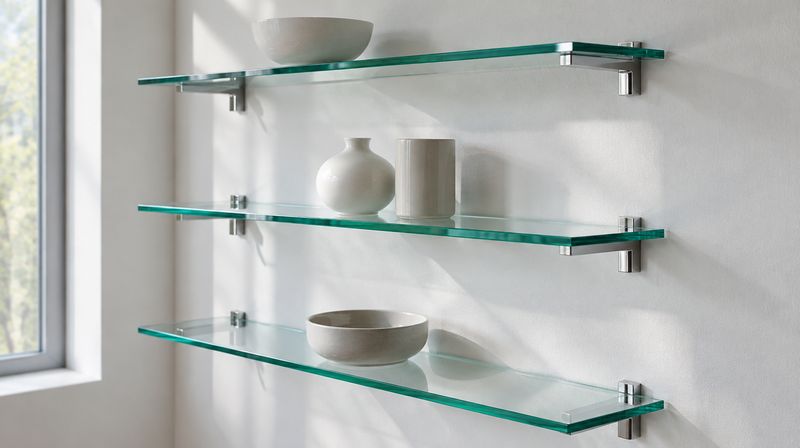
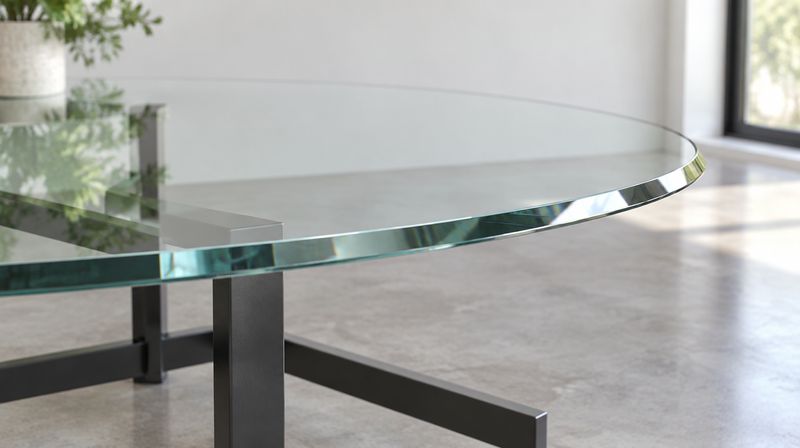
Toughened shelves and table tops with polished edges and radius corners, cut to your exact sizes.
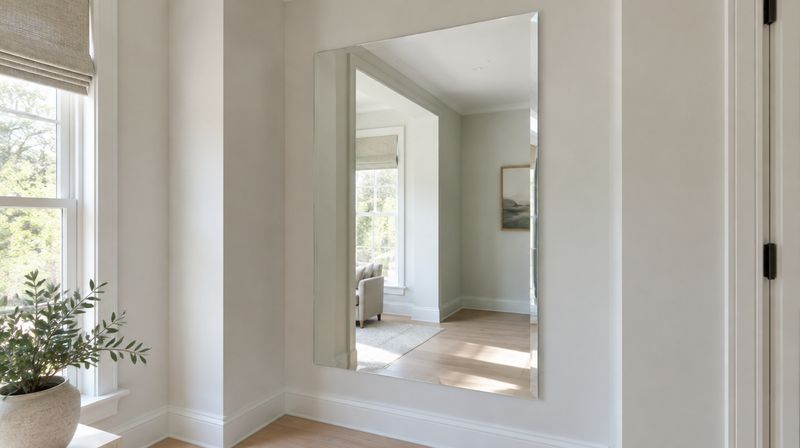
Silvered and safety-backed mirror cut to size, with polished or bevelled edges, for walls, gyms, wardrobes and alcoves.
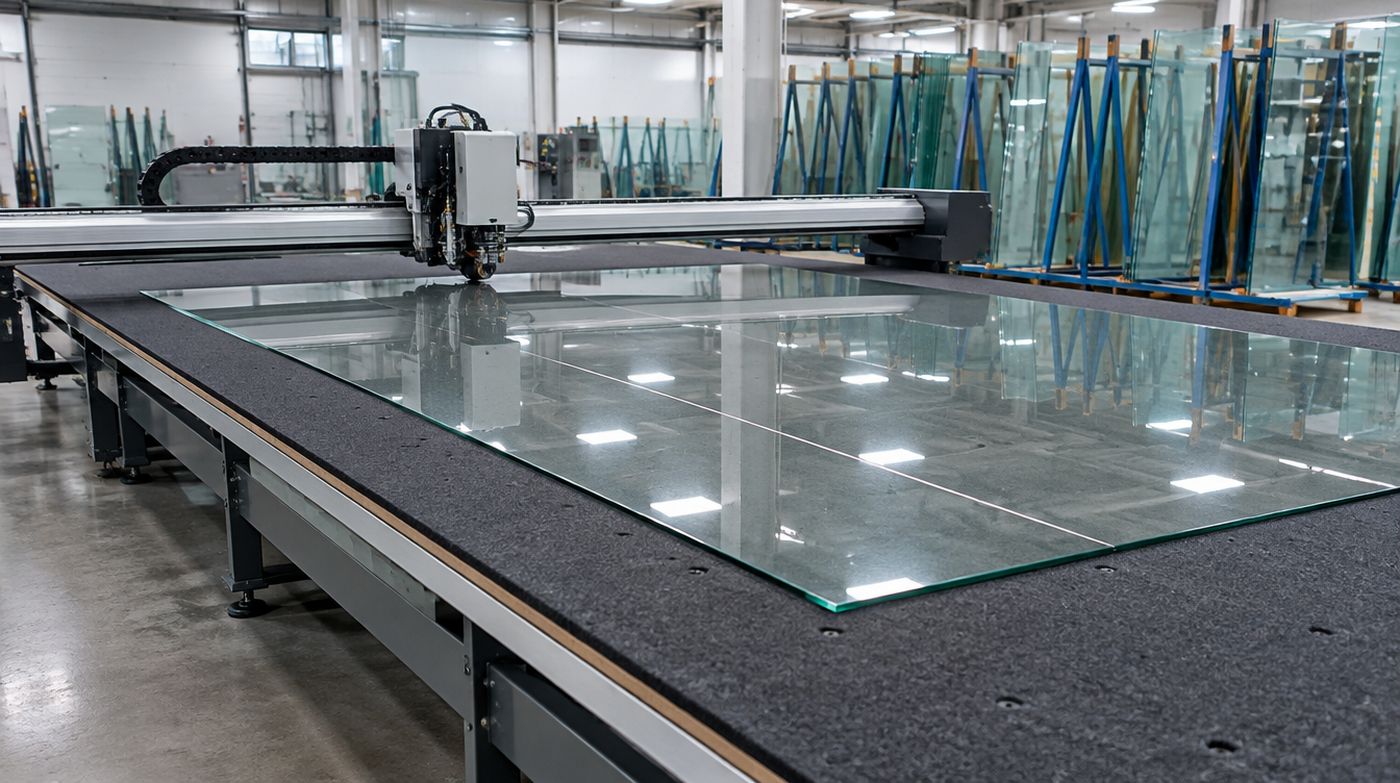
Cutting and processing for builders, joiners, shopfitters and glaziers. Trade pricing, collection from HA9 or London delivery.
The work
Illustrative images of the systems described above. Specification and finish are confirmed in writing with your quotation.
Ordering glass cut to size in London is straightforward once you know what the person cutting it actually needs from you. Almost every problem we see arrives before the glass has been touched. A width and a height written down in the wrong order. A thickness chosen because it sounded about right. A figure lifted off an old pane that had been packed out with silicone. The glass itself is the predictable part of this.
What follows is the conversation we end up having on the phone anyway. Read it and your order goes through the Wembley workshop without a phone call, and what arrives fits the hole it was made for.
Measure the width in three places, near the top, across the middle and near the bottom of the opening, and write down the smallest of the three. Do the same for the height at the left, the centre and the right. Openings are almost never parallel, and the pane has to pass the tightest point, not the average.
Then take both diagonals, corner to corner. If they agree within two or three millimetres the opening is square enough for a rectangle. If they are out by more than that, a perfect rectangle will touch in one corner and leave a visible gap in the other. That is the moment to make a template instead of sending us numbers.
Every glazed opening also needs a clearance gap, because glass expands, frames move and no rebate is dead straight. For a pane going into a timber or uPVC rebate, taking a few millimetres off each overall dimension is normal practice, and the exact figure depends on the frame and how the pane is bedded. For a shelf dropping between two uprights, two millimetres in total is usually plenty. Say which of the two figures you are giving us and we will confirm what we are about to cut.
If you are not confident in your sizes, say so when you ring. We would far rather talk it through than cut to a number you are guessing at. Cut glass is a bespoke item. Once it has been cut to your figures it belongs to you, and nobody in London can make it bigger again.
Nobody has ever regretted ten minutes with a tape measure, a piece of card and a camera. Plenty of people have regretted skipping it.
Arches, splayed reveals, a shelf in an alcove with a bowed wall, a worktop upstand, a table top with a shaped end: all of that is templated, not measured. Cut a piece of stiff card, hardboard or thin MDF and trim it until it drops into place with the clearance you want. Mark the top face, mark which way up it goes and write the job name on it. Our cutters work to the template, so what you hand over is what you get back in glass.
Photographs help more than people expect. A picture of the rebate with a tape measure lying in it tells us the depth available, whether there is beading or old putty, and whether the opening will take the thickness you have asked for. Send photographs with the sizes, not instead of them.
Thickness comes from span, loading and edge support. It is not a measure of how serious you are about the job, and the heaviest option is not automatically the right one.
For glass shelves cut to size, the number that matters is deflection rather than strength. Six millimetre glass on short brackets in a bathroom is fine. Push that same six millimetre pane out towards a metre between supports, load it with books, and it will visibly bow long before it is anywhere near breaking. That bow reads as a fault even though it is only physics. Longer spans and heavier loads want ten or twelve millimetre, or an extra bracket in the middle. Tell us the span and what is going on the shelf and we will tell you which.
Glass table tops cut to size split into two different jobs. A protective top sitting on timber or a painted surface is only there to take the knocks and the heat rings, and six millimetre with polished edges does that well. A top that is the table, sitting on a base or trestles with an overhang, is structural. That wants ten or twelve millimetre toughened, polished all round, because people lean on it, sit on the corner of it and walk children past it.
Anything in a door, immediately beside a door, or low down in a wall is a different conversation again. Those are critical locations under the building regulations and they take safety glass, which means toughened or laminated, not plain float, regardless of what came out of the frame. Replacing like for like is no defence if the original pane was wrong to begin with.
At the other end of the range, picture glass, cabinet fronts and clock faces are two, three or four millimetre float, and there is no sense in paying for anything heavier. If you ask us for six millimetre for a picture frame we will talk you out of it.
A mirror is float glass with a silver coating on the back, a protective layer over the silver and then paint over that. Everything that goes wrong with a mirror goes wrong at the back edge, where moisture reaches the silver and lifts it. The black spotting and the dark creeping fringe on an old bathroom mirror is exactly that happening.
So for a bathroom, ask for a mirror specified for damp conditions and have the edges properly worked, because a raw cut edge is an open door for water. Do not run silicone all the way round a mirror onto tile and trap moisture behind it either. Fix it with a proper mirror adhesive, which is formulated not to attack the backing paint, or use clips or screws through drilled holes with the correct washers, and leave the air behind it a route out.
Mirror cannot be toughened. Silvering will not survive a toughening furnace, so anything described as toughened mirror is either a mirrored finish applied to toughened glass, which is a different product, or a misunderstanding. What you can have is a safety backing film bonded to the rear, which holds the fragments together if the mirror is broken. On a wardrobe door, a gym wall, a stairwell or anywhere a mirror sits low down or over a hard floor, specify it and do not be talked out of it.
A bevelled edge is ground and polished at an angle around the face of the glass, usually a band of somewhere between ten and twenty five millimetres, and it is what gives a frameless mirror its chamfered line. It needs a border of plain glass to work in, so a bevel and drilled fixing holes have to be planned together rather than one after the other. Bevelling is a slow, wet, multi-stage grind, so it carries a genuine cost and a longer lead time than a flat polished edge. On a mirror that is going into a frame, it is money thrown away.
Glass arrives in stock sheets and is priced by the square metre, so people quite reasonably expect a piece a quarter of the size to cost roughly a quarter as much. It does not, and it is worth understanding why before you start comparing quotations.
Every piece carries a minimum chargeable area, because somebody has to break the sheet down, handle it, work the edges, check it and wrap it whether the piece is two metres long or two hundred millimetres. The offcut left around a small awkward shape is frequently unusable, so the sheet has to pay for it. Processing is priced by operation, so each hole, each notch and each polished edge is a separate pass by a machine or a person. And toughening is charged by the furnace load rather than by the piece, which means one small toughened pane carries a share of a whole run.
The practical consequence is simple. Order the whole job in one go instead of a pane at a time. Ten shelves on one cutting list cost far less per shelf than ten separate orders, and they come back more consistent because they are cut from the same sheet in the same run. If you know a second phase is coming in a fortnight, tell us now and we will cut it with the first.
Trade customers already send lists like this. Homeowners can too, and it is the single best thing you can do to avoid a remake.
Dimensioning from a named edge is not pedantry. A hole fifty millimetres in from the bottom edge is unambiguous. A hole fifty millimetres from the bottom becomes a guess the moment somebody turns the pane over on the bench, and on patterned or coated glass the wrong face means the whole piece is scrap.
Plain float and mirror cut to size, with arrissed or polished edges, is quick work. The sheet is in the rack, the cutting table is in the next room, and the only real question is where your pieces land in the day's run.
Everything beyond that adds time for a reason worth knowing. Toughening is a heat process that runs as a batch, so your pieces wait for a load and then wait to cool, which is why a toughened order is measured in working days and not in hours. Bevelling, shaped work and long runs of drilling are machine time. Low-iron, particular obscure patterns, body-tinted and solar control glass are not always stock and may come in on a supplier delivery. Unusual laminated interlayers are the same. Ask for a date when you place the order rather than afterwards, and tell us if one piece on the list is holding up another trade.
How it works
Four stages, and we tell you where you are at each one.
Send your sizes, or we measure on site. Width first then height, in millimetres — and tell us the tolerance you can live with.
We confirm the glass type, thickness, edgework and whether safety glass is a requirement in that position.
Cut, edged and processed in Wembley. Holes, notches and radius corners are made before toughening, never after.
Collect from our unit, or we deliver across London. Glass travels on edge and we pack it accordingly.
Specification
Every quote states the glass build, the standards it is made to and the hardware. If a quote you are comparing does not, that is worth asking about.
Cutting, edgework, drilling and toughening all happen on Atlas Road in Wembley, which is why you can collect the same week.
| Item | Specification |
|---|---|
| Glass types | Clear float, low-iron, toughened, laminated, mirror, obscure patterns, tinted and solar control. If it is flat glass we can usually source and process it. |
| Thicknesses | 2mm to 19mm depending on type. 4mm and 6mm cover most domestic work; 10mm and 12mm for shelving, table tops and frameless applications. |
| Edgework | Arrissed (dulled edge, hidden applications), ground flat, polished flat, or bevelled. Any exposed edge should be polished at minimum — a cut edge is sharp and chips easily. |
| Cut-outs | Holes, notches, radius corners and shaped cuts, all made before toughening. Once glass is toughened, nothing can be cut, drilled or trimmed. |
| Tolerances | We cut to approximately +/- 1mm on float glass and +/- 2mm on toughened, which is the industry norm. Tell us if your application needs tighter and we will say whether it is achievable. |
| Safety glass requirements | Toughened or laminated glass is required by Approved Document K in doors, in side panels within 300mm of a door, and in glazing below 800mm from floor level — 1500mm in doors and side panels. We will flag it rather than leave it to you. |
FAQ
Price depends on the glass type, thickness, area and edgework, and toughening roughly doubles the glass cost. A small float shelf is a few pounds; a large toughened low-iron table top with polished edges and radius corners is a different order of figure. Send sizes and what it is for and we will price it properly — the application often changes what you actually need.
No, and nobody can. Toughening is a heat treatment applied to glass that has already been cut to its final size with every hole and cut-out in it. An existing pane cannot be put through the furnace and come out as a toughened version of itself. If you need toughened glass, it is made from scratch to your sizes.
It depends on the position, and in several of them it is a legal requirement rather than a preference. Approved Document K requires safety glass in doors, in side panels within 300mm of a door, and in glazing below 800mm from the floor. Beyond the regulations, anything you lean on, put weight on or might walk into — shelves, table tops, low windows — should be toughened. For a picture frame or a cabinet door, float is fine.
Width first, then height, in millimetres, and measure the opening in three places because frames are rarely square. Tell us whether the figure you are giving is the size of the glass you want or the size of the hole it has to go into — that single ambiguity causes more wrong panes than anything else. If you are unsure, we will come and measure.
Both. Collection is from our unit at 6 Atlas Road, Wembley HA9 0JH during opening hours — call first so your glass is ready and someone is free to load it. We deliver across London. Glass must travel on edge, never flat, and we pack it accordingly; if you are collecting, bring something to stand it in.
Yes. We cut and process for builders, joiners, shopfitters, kitchen fitters and other glaziers, with trade pricing and accounts available. Send a cutting list and we will come back with a price and a lead time.
In detail
A page on each part of what we do, written to answer the question properly rather than to sell.
Cut, processed and toughened to your sizes in Wembley - with every hole and cut-out made before it goes into the furnace.
Most people approach a glass cutting service London has to offer with a size in hand and an assumption that the cutting is the easy part. Mostly it is. The exceptions are worth knowing before you pay, because some glass cannot be cut at all.
Bespoke glass cut to size means anything that is not a plain rectangle. This page is about how a shaped panel is actually produced, what we need from you to produce it, and the jobs where a shaped panel is the wrong answer.
A glass table top is one of the few pieces of glass in a house that people lean on, slide things across and sit against all day. Glass table tops cut to size are easy to order and easy to under-specify, so this page is about the four decisions that matter.
Nearly every sagging or broken glass shelf is a span problem rather than a weight problem. Order glass shelves cut to size with the span and the bracket positions in mind and the shelf will outlast the wall it is fixed to.
Ordering replacement glass panels is mostly detective work. You need the right size taken from the frame rather than the broken piece, and a reasonable idea of what the original glass was.
If you have searched for glass cutters near me, you want someone who can take a size and hand you a finished pane. Here is what that transaction should look like, and how to describe your job so the price you are quoted is the price you pay.
Ordering from a glass merchant cut to size is a different transaction from buying anything else in the building trade, because the product does not exist until you have described it. Getting the description right is most of the job.
Coverage
We cover Greater London from our Wembley workshop, with most work in north, west and central London. See the full list of areas.
Give us the glass type, thickness and sizes in millimetres, or a cutting list. We will come back with a price and a lead time.