Glass cutting service in London: what can be cut, and what can’t
Most people approach a glass cutting service London has to offer with a size in hand and an assumption that the cutting is the easy part. Mostly it is. The exceptions are worth knowing before you pay, because some glass cannot be cut at all.
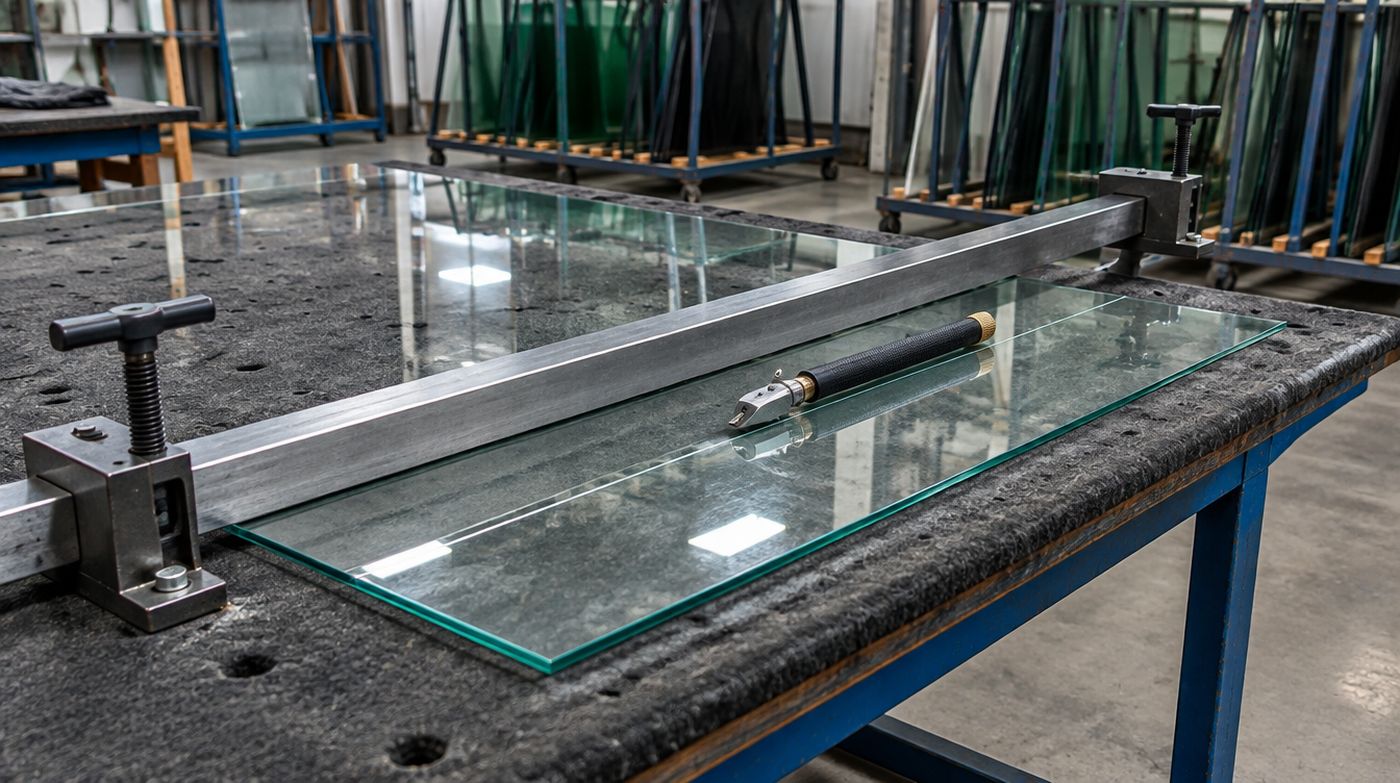
What a glass cutting service London offers can and cannot cut
Every glass cutting service London offers works the same way, whatever the website suggests. A hardened wheel scores the surface of annealed glass and the sheet is broken along that score. That is the whole trick, and it has been the whole trick for a century. It means some glass cuts beautifully, some cuts badly, and some cannot be cut at all once it has been manufactured. Knowing which category your job falls into saves you a wasted trip to Wembley and, more often, saves you buying the same panel twice.
Clear float cuts. Low-iron cuts. Tinted, patterned, sandblasted and mirror all cut. Thicknesses from 2mm picture frame glass up to 19mm structural plate are all workable, with the thicker sheets needing a heavier wheel, more pressure and a far more patient break-out. Laminated cuts, but by a different method, which we come to below. Wired glass cuts, reluctantly. Toughened glass does not cut at all. Neither does a sealed double glazed unit in any sense you would want to pay for.
Why toughened glass cannot be cut, and what that means for your order
Toughening works by heating glass to around its softening point and then chilling the surfaces rapidly. The faces end up in compression and the core in tension, locked permanently against each other. That stored energy is what makes the pane strong. Score it anywhere and you release the lot: the whole sheet dices into thousands of small fragments in a fraction of a second. There is no trimming a toughened panel, no shaving 5mm off one edge, no drilling an extra hole after the fact.
Which is why every toughened order is cut, shaped, drilled and polished first, and only then goes through the furnace. We set out the furnace sequence and what it demands of your figures on our toughened glass cut to size page, so we will not repeat it here. The practical consequence is the part that matters on this page: a toughened panel that turns out 10mm too big is scrap. Not adjustable. Scrap.
People do not really believe this until they have paid for the same panel twice. If you are working off an aperture you are not confident about, there are two sensible moves. Order a cheap float pane first and use it as a physical trial fit, then order the toughened one from the dimensions that actually worked. Or, if the panel sits in a frame or channel, err 2mm to 3mm under rather than over. A small gap can be packed, glazed or trimmed. An oversize toughened panel can only be looked at sadly.
Tolerances: what cut to size means in millimetres
Nobody cuts glass to zero. On smaller annealed pieces we work to roughly a millimetre either way on each dimension, which is tight enough that you will never notice it. The allowance opens up a little as the sheet gets bigger, because a 2.5 metre score has to be broken out by hand and glass does not bend to order. Toughened glass carries a wider tolerance again, because heat is involved. Panels come out of the furnace with slightly more movement in both dimensions and a little more variation in squareness than they went in with. That is normal, it is recognised in the product standards, and it is one of the reasons a toughened panel is never specified to fit an opening with no gap.
This is where the single most common ordering mistake happens, and it is not a mistake in the workshop. A customer measures the aperture exactly, writes down the aperture size, and expects the cutter to take off a clearance. The cutter is handed a finished size and cuts to it. Or worse, both parties deduct, and a panel arrives 6mm small in both directions. So be explicit. Tell us whether the figures you are giving are the hole or the glass. If they are the hole, say what the frame or channel is and we will tell you what we are taking off and why.
Squareness, diagonals and why your opening is not a rectangle
Take both diagonals of any opening in a London house and they will differ. Four or five millimetres across 800mm is routine in a Victorian frame, and we have measured far worse in alcoves either side of a chimney breast. Glass is cut square. Your building is not. Something has to absorb the difference.
If the panel sits inside a frame, the clearance gap absorbs it and nobody ever knows. If the panel sits proud on a worktop, or spans an alcove wall to wall, the discrepancy shows as a tapering gap at one end. At that point you have a choice: scribe the glass to the actual shape, or accept a rectangle and close the gap another way.
Honestly, a rectangle plus a slim trim, a bead of neutral cure silicone or a 10mm shadow gap is the right answer far more often than a shaped panel. Scribing costs money, needs a template, and locks you into a piece that fits exactly one wall in exactly one orientation. We cover template work properly on our bespoke glass cut to size page. Read it before you commit to a shaped piece, because a good proportion of people who ask for one do not need one.
Cutting laminated, wired and patterned glass
Laminated glass is two or more panes bonded to a plastic interlayer, so it cannot simply be scored and snapped. Both faces are scored in register, both panes are broken, and then the interlayer is parted with controlled heat and trimmed back. Done well the result is clean. Done badly you get a stepped edge and a ragged film. Thinner laminates such as 6.4mm and 8.8mm are straightforward. Thick multi-ply constructions and anything with a stiff structural interlayer are a different proposition and are better ordered at finished size from the start.
Wired glass fights you. The mesh resists the break, so the edge comes off rougher than plain float and the odd wire end needs dressing. Worth saying plainly: if you are replacing wired glass because a door or screen needs fire resistance, a cut-to-size pane of ordinary Georgian wired may not satisfy that requirement at all. Fire resistance is a property of a tested glass and frame assembly, not of the wire. Check what is actually specified before you spend anything.
Patterned glass cuts on its smooth face, and the direction the pattern runs matters if you are ordering more than one panel for the same room. Get that wrong and two panels that should match will not. There is more on pattern run and ordering conventions on our glass merchant cut to size page.
Minimum and maximum sizes, and why small pieces are awkward
Small pieces are harder than large ones, which surprises people. A 40mm wide strip has to be gripped, scored, broken out and fed through a polishing machine without snapping, which takes much the same setup as a panel twenty times its area. That is the reasoning behind a minimum charge, and our glass merchant cut to size page explains how to get the most out of one.
At the other end, the limits are stock sheet size and the practicalities of moving the finished panel. Most jobs are nowhere near the cutting limit. They are limited by whether two people can get the panel up a staircase, round a half landing, or into a lift in a mansion block. Measure that route before you order anything large. We would much rather split a job into two panels with a joint than deliver one panel that cannot physically reach the room it was made for.
Where people waste money on a glass cutting service
Four places, repeatedly, and any glass cutting service London has that is worth using will talk you out of all of them if you ask.
- Polished edges on an edge that will be hidden under a frame, a bead or a trim, where a clean arrised edge does the same job for less.
- Low-iron glass on a panel whose edges are concealed, since the main reason to pay for low-iron is that the green tint shows on an exposed edge.
- Toughening a cabinet shelf that nobody can walk into, sit on or fall against. The regulations are about critical locations, not about every piece of glass in the house.
- Delivery of a single small pane that would travel perfectly safely in the back of your own car, properly padded and stood on edge.
One more. If a quotation prices a 2mm picture frame pane at the same rate per square metre as a structural panel, question it. Thin annealed float is one of the cheapest materials in the building trade, and most of what you are paying for on a small pane is handling, not glass.
What happens if we think your order is wrong
We ring you. If a size looks like a transposed figure, or a thickness looks light for the span, or a shelf is specified in float when it is going in a bathroom at hip height, you will get a phone call before anything is scored. We will not quietly cut exactly what was written down and let you discover the problem on site.
What we cannot do is take responsibility for figures we did not take ourselves. If you measured the aperture, the dimensions are yours. If we surveyed it, they are ours and we will remake the panel at our cost. That line is worth being clear about at order stage rather than afterwards, and any cutting service that is vague about it is telling you something.
If you are not certain of a dimension, say you are not certain. A thirty second phone call costs nothing. A second toughened panel costs what the first one cost.
Cutting glass yourself, and when that is sensible
There is no mystique to cutting 3mm or 4mm annealed float. An oil-fed wheel cutter, a straight edge, a firm single pass and a confident break over a dowel will give you a serviceable picture frame pane or greenhouse pane for the price of the sheet. If that is your job, and you are replacing one of twenty identical greenhouse panes, cutting them yourself is a perfectly rational decision and we will tell you so.
Stop at the point where the job needs anything else. Anything over about 6mm needs more force than a kitchen table will tolerate. Anything shaped needs a template and a shaping machine. Anything that needs a polished edge needs a machine you do not own, because hand-dressing an edge with wet abrasive paper looks exactly like what it is. Anything that has to be toughened has to be cut to final size before the furnace, so DIY accuracy becomes expensive accuracy. And anything in a critical location under Approved Document K needs to be safety glass, which means a factory process, not a wheel and a straight edge.
FAQ
Questions about glass cutting service london
Can you cut glass that I already have?
As a rule we do not. We cannot see the history of a sheet we did not supply, and old glass carries edge chips, surface scratches and sometimes internal stress from however it has been stored. Score near a hidden flaw and it breaks on the bench rather than on the line, which wastes everyone’s time and leaves the question of who pays. If the glass is toughened it cannot be cut at all. In most cases a new piece of annealed float is cheaper than the labour of salvaging an old one, and you get a warranted edge and a clean face.
How accurate is glass cut to size?
On ordinary annealed glass at domestic sizes, expect around a millimetre either way on each dimension, widening slightly on very large panels because long scores are broken out by hand. Toughened glass is less tight again, because the furnace moves both the size and the squareness a little. That is why glass is never specified to fill an opening exactly. You want two or three millimetres of clearance all round for a framed pane so the frame can move and the glazing bead can seat. Tell us whether the figures you give us are the aperture or the finished glass, so the clearance is deducted once and not twice.
Is it cheaper to cut glass myself?
For thin annealed float in simple rectangles, yes, and we will say so. A greenhouse pane or a picture frame pane in 3mm or 4mm needs a wheel cutter, a straight edge and one confident pass, and the sheet costs very little. It stops being sensible the moment the job involves thickness over about 6mm, a shaped edge, a polished edge, a drilled hole, or glass that has to be toughened, because toughening demands the final size and finish before the panel enters the furnace. It is also the wrong call for any critical location, where safety glass is required.
Send us your sizes
Give us the glass type, thickness and sizes in millimetres, or a cutting list. We will come back with a price and a lead time.