Glass table tops cut to size: getting the spec right
A glass table top is one of the few pieces of glass in a house that people lean on, slide things across and sit against all day. Glass table tops cut to size are easy to order and easy to under-specify, so this page is about the four decisions that matter.
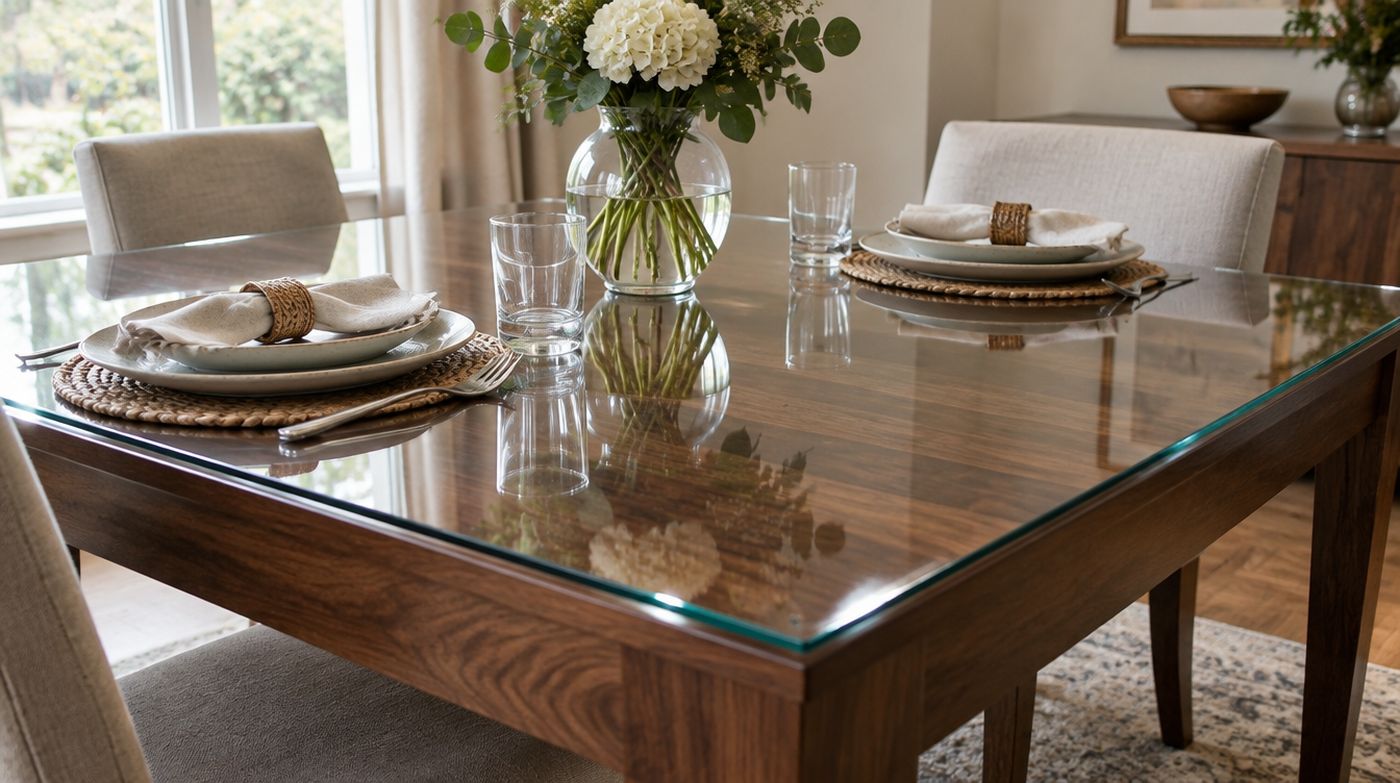
Glass table tops cut to size: what thickness for what span
Thickness on a table top is not a styling choice, it is a structural one, and it is driven by how far the glass has to reach between supports rather than by the overall size of the top. A 1.8 metre top sitting on a solid timber table needs less glass than a 900mm top bridging two pedestals, because the first one is fully supported and the second one is spanning.
For a top laid on a continuous existing surface, where the glass is supported across its whole area, 4mm or 6mm is plenty and the thickness is chosen for appearance and handling rather than strength. For a top resting on a frame or on rails, with the centre unsupported, 8mm is the sensible floor and 10mm is the comfortable answer at dining table sizes. For a top on two pedestals, a trestle pair, or a single central base, you are into 10mm or 12mm, and at larger spans 15mm stops being extravagant and starts being necessary.
Toughened, in every case where the glass is the table rather than a cover over one. Annealed float of the same thickness has similar stiffness but fails in large sharp pieces, and a dining table is exactly the sort of place where people fall against glass. Toughened to BS EN 12150 breaks into small blunt fragments instead. The cost difference on a table-sized panel is not large enough to be worth thinking about.
Overhang, support and the cantilever problem
The number that catches people out is not the span, it is the overhang. Glass projecting past its last support behaves as a cantilever, and someone will eventually lean on that corner, sit a laptop on it, or let a child hang off it. On a base that is much smaller than the top, which is the look most people want, that overhang is where a top will fail.
Keep the overhang modest in proportion to the base, and increase the thickness rather than the overhang if you want a lighter looking table. If you have a 400mm diameter pedestal and you want a 1.2 metre round top, the glass is doing a lot of work and 12mm is the starting point, not 10mm. If your base is a frame that comes out close to the edges, you can go thinner for the same top.
Tell us the base dimensions and the layout of the supports when you order, not just the top size. We can only advise on thickness if we know where the glass is held. A quote given purely from length and width, with no question about the base, is a quote from someone who is selling glass rather than specifying a table.
Protector tops versus a glass table top in its own right
These are two different products and they are priced and specified differently, so decide which you want before you ask for a price.
A protector top is a sheet laid over an existing table to save the surface from heat, water rings and scratches. It is fully supported, so it can be 4mm or 6mm, and in that position annealed float is defensible because the glass cannot be fallen through. It should have polished edges, because the edge sits at hand height and in plain view, and it wants small clear pads or a thin felt interlayer so it does not sit hard on the timber.
A table top proper is the working surface. It is toughened, it is thicker, it carries the load, and the edge treatment and corner radius matter for safety rather than only for looks. If you are buying one, buy it as one. People regularly order a 6mm protector thickness for a top that is actually spanning a frame, because the quote was cheaper, and the result is a table that flexes visibly when someone leans on it.
If all you want is to stop a dining table getting ring-marked, buy the protector and spend nothing more. A 10mm toughened top is not better at protecting timber than a 4mm one. Pay for thickness only where thickness is doing something.
Corner radii, and why square corners are a poor idea on a table
A 90 degree corner on a glass top is at exactly the height to meet a hip, a thigh or a child’s head, and it is also the most vulnerable point on the panel. Every knock a table takes finds the corners first. On toughened glass a sharp corner is a stress concentration and a chip there can set the whole pane off.
So radius them. A 10mm to 15mm radius is almost invisible from across the room and transforms how the corner behaves. Something larger, say 25mm to 50mm, reads as a deliberate design detail and is kinder still in a tight dining room or a flat where people have to edge past the table. All radii are ground before toughening, so decide at order stage.
On a round top there are no corners to worry about, which is one reason round glass tops suit small London rooms where you are walking past the table rather than around it.
Edges that are safe to lean against
The site covers edgework generally on other pages, so here is only what is specific to table tops. A table edge is touched, leaned on and brushed past constantly, so an arrised edge is not sufficient. You want a flat polished edge as a minimum, which is ground flat, mitred slightly at the arrises and polished to clear.
Beyond that it is appearance. A pencil round or bullnose edge feels softer under a forearm and reads well on thicker glass. A bevel, typically around 20mm, catches the light and suits a traditional room, but it is the most expensive option and on 10mm or 12mm glass it starts to look heavy. A flat polished edge is the right choice for most tables and is the one we would recommend if you asked us to pick.
If a quotation offers you a bevelled edge as standard on a modern table top, ask what it costs against a flat polish. The difference is usually worth knowing before you agree to it.
What the glass does to the surface underneath
Glass laid directly onto timber traps moisture against the finish. On a sealed modern lacquer that is usually harmless. On an oiled or waxed antique, or on anything with a shellac finish, it can bloom the surface or lift it over months, and you will not see it happening until you take the glass off.
So use pads. Small clear self-adhesive pads at the corners and at intervals along the edges hold the glass a fraction of a millimetre clear and let air move underneath. Clear silicone or vinyl pads are the usual choice. On a valuable timber top, a thin felt or baize layer is better than nothing but holds damp more than pads do, so pads first.
Pads also stop the glass sliding, which matters more than people expect on a polished table. And they take up the tiny unevenness in any timber surface, which otherwise loads the glass on high spots. A pane bearing on three hard points rather than evenly is a pane under unnecessary stress.
Heat, scratches and living with a glass top
Toughened glass handles a hot plate from the oven without drama. What it does not tolerate well is a sharp, localised temperature difference, so a very hot pan placed on a cold top is still worth avoiding, and a trivet costs almost nothing.
Glass does not scratch from ordinary use, but it does scratch from grit, so grinding a gritty cloth across it in circles is the main risk. Clean it with plenty of water and a squeegee or a microfibre cloth rather than a dry wipe. Avoid abrasive creams entirely.
Do not lift a large top flat. Carry it on edge, with two people, and never let a corner touch the ground. The great majority of broken table tops we hear about were broken while being moved, not in use.
Where people overspend on a glass table top
Three places. Low-iron glass on a top whose edges are hidden by a frame is money gone, because the reason to pay for low-iron is the green edge tint, and you cannot see an edge you have covered. A heavy bevel on a thick modern top usually fights the design you are paying for. And thickness above what the span needs buys you nothing but weight, which makes the top harder to move and harder to live with.
On the other hand, there is one place where saving money is a mistake. If the glass is the table, toughen it. A protector top over timber can reasonably be annealed. A top that someone could fall against should not be, and anyone selling you an annealed dining table top at a dining table thickness should be asked why.
When you ask us for glass table tops cut to size, give us the top size, the base layout, the thickness you had in mind and what the table is for. If the thickness looks wrong for the span, we will say so before we cut anything, and if you have specified more glass than the job needs we will say that too.
FAQ
Questions about glass table tops cut to size
What thickness glass should a table top be?
It depends on the span between supports, not the overall size. A top fully supported on an existing table can be 4mm or 6mm, since the glass is only a protective cover. A top resting on a frame with an unsupported centre wants 8mm to 10mm at dining sizes. A top on two pedestals or a single central base is 10mm to 12mm, and larger spans or big overhangs push that to 15mm. Any top that is the working surface rather than a cover should be toughened, because the failure mode of annealed glass at that size is large sharp pieces.
Should a glass table top have radius corners?
Almost always, yes. A square corner sits at hip and head height, it takes every knock the table receives, and on toughened glass a chipped corner can set off the whole pane. A 10mm to 15mm radius is barely visible from a metre away and changes how the corner behaves completely. A larger radius of 25mm to 50mm looks deliberate and is kinder still in a narrow room where people squeeze past. Corner radii are ground before toughening, so they must be decided when you order rather than added afterwards.
Will a glass top damage the table underneath?
It can, if it sits directly on the timber. Glass traps moisture against the finish, which is usually harmless on modern lacquer but can bloom or lift an oiled, waxed or shellac surface over a period of months without you noticing. Fit small clear self-adhesive pads at the corners and at intervals along the edges so the glass sits a fraction clear and air can move under it. The pads also stop the glass sliding and spread the bearing evenly, which keeps the pane off high spots in the timber. Felt or baize is a poorer second choice because it holds damp.
Send us your sizes
Give us the glass type, thickness and sizes in millimetres, or a cutting list. We will come back with a price and a lead time.