Areas we cover across London
We work from our workshop at 6 Atlas Road, Wembley HA9 0JH, across Greater London and the near Hertfordshire border.
Core coverage
Where most of our work is
Being based in Wembley means north, west and central London are on our doorstep. These are the areas we are in most weeks.
- Wembley
- Harrow
- Brent
- Ealing
- Camden
- Westminster
- Kensington & Chelsea
- Hammersmith & Fulham
- Barnet
- Islington
- City of London
- Watford
Full list
Every area we survey and install in
- Wembley
- Harrow
- Brent
- Ealing
- Acton
- Willesden
- Kilburn
- Camden
- Islington
- Westminster
- Marylebone
- Fitzrovia
- Mayfair
- Kensington
- Chelsea
- Hammersmith
- Fulham
- Chiswick
- Shepherd's Bush
- Notting Hill
- Maida Vale
- St John's Wood
- Hampstead
- Highgate
- Finchley
- Barnet
- Mill Hill
- Edgware
- Stanmore
- Pinner
- Northwood
- Ruislip
- Uxbridge
- Hayes
- Southall
- Greenford
- Wood Green
- Enfield
- Walthamstow
- Hackney
- Shoreditch
- City of London
- Clerkenwell
- Southwark
- Battersea
- Wandsworth
- Richmond
- Twickenham
- Kingston
- Watford
- Bushey
- Borehamwood
Not on the list? If you are within the M25 it is worth a call. We travel for larger projects and can usually fit a survey around work already booked nearby.
What we do across these areas
- Toughened glass cut to size
- Glass cutting service in London: what can be cut, and what can’t
- Bespoke glass cut to size: templates, shapes and awkward openings
- Glass table tops cut to size: getting the spec right
- Glass shelves cut to size: span, load and the brackets
- Replacement glass panels: measuring and matching the pane you lost
- Glass cutters near me: what to expect, and what to send them
- Buying from a glass merchant cut to size
Collecting from the Wembley workshop
Every piece of glass cut to size on this site leaves from one address: 6 Atlas Road, Wembley HA9 0JH, on the industrial estate behind Wembley Park, open Monday to Friday from eight until five. Most trade customers collect rather than wait for a delivery slot, and the other advantage is that you can check your pieces on the rack before you load them.
Getting to us is easiest off the North Circular. Come in from the Neasden or Harrow Road end and work through Wembley Park, and allow for the obvious local fact: on a stadium event day the roads around HA9 change character completely and the surrounding streets fill with parked cars. If your week has any flexibility in it, avoid those afternoons. Atlas Road itself is an industrial street, so there is room to pull up and load properly, which is more than can be said for most of the addresses we deliver to.
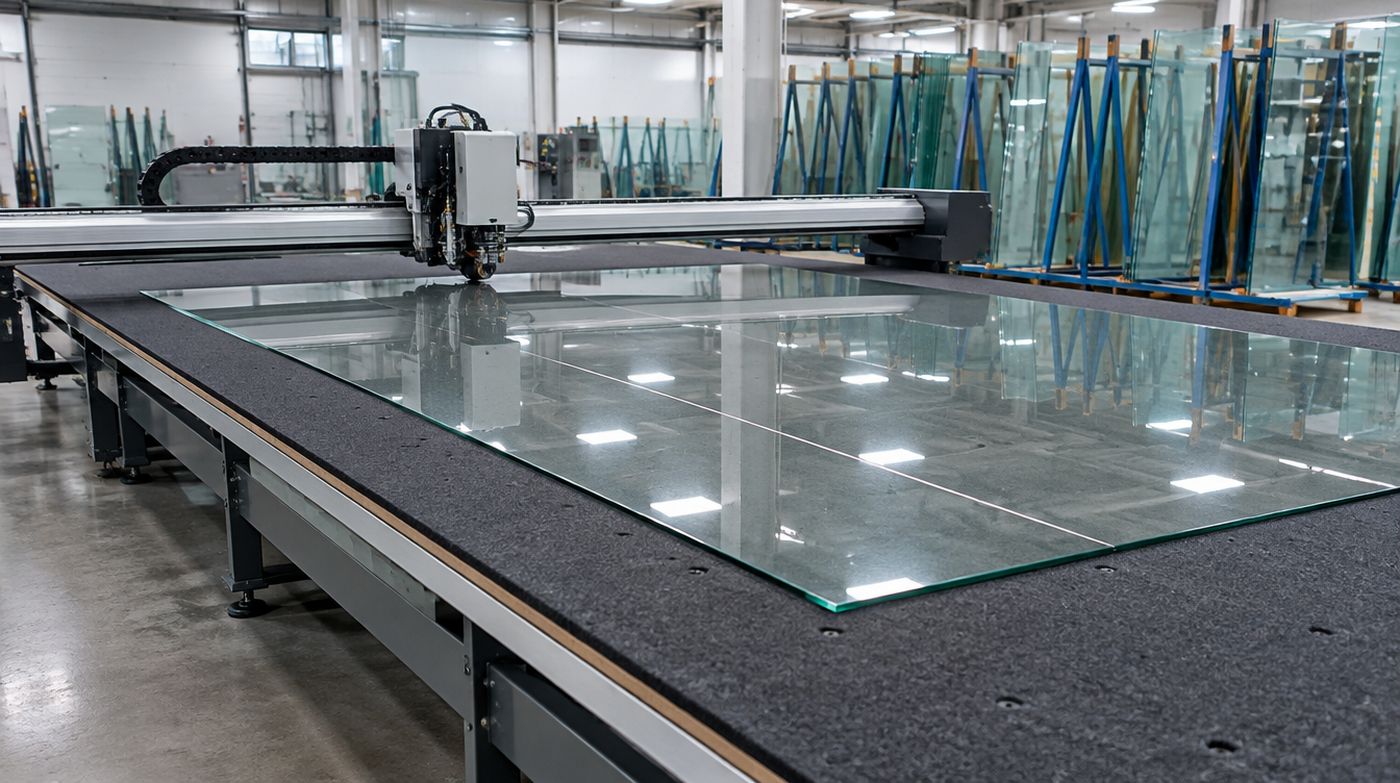
Think about the vehicle before you set off, because a sheet is only as transportable as the thing you arrived in. A van with a bulkhead you can lean glass against, or a proper A-frame, beats an estate car for anything much over a metre. Bring blankets, offcuts of carpet, polystyrene or stiff cardboard to separate the pieces, and a strap you can tension against a flat edge rather than across a corner. Glass travels on edge, leaning slightly, never laid flat on the van floor where every speed hump in Brent flexes it across its weakest axis. We will help you load, but we cannot turn a hatchback into a glass van.
If you cannot collect safely, say so on the phone and we will quote the delivery instead. There is no pride in a cracked table top in a car park.
Delivering across north west and west London
Wembley sits in Brent, so the closest work is the simplest. Alperton, Sudbury, Harlesden, Willesden, Neasden and Kilburn, out through Harrow, Wealdstone, Pinner, Stanmore and Edgware, then down through Ealing, Acton, Greenford, Perivale and Hanwell towards Brentford, Chiswick and Hounslow. A lot of that is interwar semi-detached and 1930s terraced housing with a front drive, or at least a kerb you can legally stand on for ten minutes. It makes a real difference: a long sheet can come off the vehicle and go straight down the side of the house without ever entering a hallway.
The exceptions are worth flagging when you book rather than discovering together on the day. The mansion blocks and large converted houses around Maida Vale, Kilburn and Queen's Park frequently have no off-street space at all and a narrow communal staircase with a turn halfway up, and that turn is the single most common reason a large pane cannot be got into a flat. Measure the stairwell, not just the room. The newer blocks around Wembley Park, Alperton and Park Royal mean something different: a booked loading bay, a goods lift with a stated maximum internal length, and a concierge who needs telling we are coming. Find out the lift dimensions before you order glass that is longer than them, because no amount of goodwill at the door will fix it.
Central London deliveries, and why the booking matters
Deliveries into the City, Westminster, Soho, Mayfair, Fitzrovia, Marylebone, Covent Garden, Holborn and Clerkenwell are entirely routine and need planning rather than optimism. The Congestion Charge applies on weekdays and into the evening, and the whole of London sits inside the ULEZ, so those costs attach to a central job whoever is making the delivery.
The real constraint, though, is the kerb. Loading restrictions on red routes and across a lot of central borough streets rule out stopping at certain hours altogether, and where there is a timed loading bay the clock is short and the bay is shared with everybody else's deliveries that morning. Unloading a two metre sheet with two people takes a few minutes, but it takes those minutes at the kerb, not fifty metres away round the corner, because glass carried a long way through a crowd is glass at risk. If you are fitting out a shop, a restaurant or an office, tell us your loading window when you order and we will build the run around it. If the building has a basement goods lift or a service road at the back, tell us that too, because it changes which vehicle we send.
Shopfront and fit-out work in central London often has to happen outside trading hours anyway, and glass for those jobs is frequently better collected or delivered the day before and stored on site than delivered into the middle of a morning rush. If you do that, store it on edge, on battens, against a solid wall, and tell the other trades it is there before somebody leans a sheet of plasterboard on it.
The inner boroughs: Victorian terraces, parked streets and no side access
Camden, Islington, Hackney, Haringey, Lambeth, Southwark, Wandsworth, Hammersmith and Fulham, and Kensington and Chelsea are where the housing stock decides how a delivery goes. Streets of Victorian and Edwardian terraces in Stoke Newington, Highbury, Crouch End, Clapham, Balham, Peckham, Fulham and Shepherd's Bush are in controlled parking almost everywhere, often resident bays with no visitor provision at all, and the carriageway is one vehicle wide once both sides are parked.
For cut glass that matters in a very particular way. The pane has to be walked from wherever the vehicle can stop, through a front door, usually round a tight hall dog-leg, and sometimes down to a lower ground floor. A one metre shelf is nothing. A twelve millimetre table top or a full-height shower panel is a two-person carry that needs a clear, planned route, and the route is the bit nobody thinks about until the glass is on the pavement. Walk it yourself before you order, carrying a piece of card or a length of timber the same size as the glass, and pay attention to the turn at the bottom of the stairs.
Conservation areas and listed buildings across these boroughs add a second layer, and that one is about specification rather than access. In a conservation area the appearance of glass in a front elevation can be controlled, which is why original patterned and leaded glass is more often replicated than swapped for modern frost, and why a slim or specialist unit is sometimes the only acceptable way to improve a sash window. If the property is listed, consent is a question for the local authority before anything is ordered, and we will not cut a replacement for a controlled front elevation on the assumption that it will all be fine.
The Victorian rebate is a problem of its own. Old timber beads, a century of paint and hard putty mean the opening you measure today is not the opening you will have once it has been raked out. Where we are supplying into a frame like that, we would far rather survey it or have you template it than cut to a tape reading taken against putty that is about to be chiselled away.
North, south and the outer boroughs
North through Barnet, Finchley, Mill Hill, Southgate, Enfield and Palmers Green, and out to Bromley, Croydon, Sutton, Kingston, Richmond, Bexley, Havering, Hillingdon and Redbridge, the pattern changes again. More 1930s semis and post-war estates, more driveways, more side gates, and a far better chance of bringing glass in from the garden rather than through the house. That makes large panes much easier, and it is often the difference between specifying one sheet and splitting a job into two.
What the outer boroughs cost you instead is road time. A delivery to Croydon or Romford is an hour each way on a bad day, so those runs are grouped by day and direction rather than dropped in on request, and south of the river the river crossings make that worse. If a job in Bexley or Bromley has to land at a particular hour because a fitter is booked, say so early and we will put it into the right run rather than promising something the traffic will not allow.
New-build flats anywhere in London, and there are a great many across Wembley, Barking Riverside, Nine Elms and the Royal Docks, behave like central deliveries whatever the postcode. A bay to book, a lift with a limit, a concierge, a delivery window and a management company that may want to see paperwork before anything comes through the door. Ask the building for the lift's internal length rather than guessing, because that single number decides your maximum pane size, and nothing we do in the Wembley workshop can change it.
What to have ready when a delivery arrives
A delivery of cut glass is not a parcel being dropped on a step. Two things make it go smoothly: somewhere legal to stop within carrying distance, and someone on site who knows what is coming and where it is going.
- A phone number for somebody actually at the address, not the office
- A clear route in, with doors wedged, hall furniture moved and the floor protected
- A second pair of hands for anything long, thick or beyond a comfortable single lift
- Somewhere to store it: on edge, on timber battens, leaning against a solid wall, away from the other trades
- Any building rules we need in advance: loading bay booking, lift dimensions, access codes, permitted delivery hours
Check the pieces against your list while the driver is still there, looking at edges and corners in particular, because that is where damage hides. Once glass is inside a building and unwrapped, nobody can honestly say whether a chipped corner happened on the road or on the stairs, and everybody would rather settle that question at the kerb than argue about it a week later.
If you are working across several London sites, ring 020 4634 6045 before the glass is cut and we will sort out the labelling and the drops at the order stage. It is the difference between a smooth week and a van full of panes that belong to somebody else's job.
Send us your sizes
Give us the glass type, thickness and sizes in millimetres, or a cutting list. We will come back with a price and a lead time.