Replacement glass panels: measuring and matching the pane you lost
Ordering replacement glass panels is mostly detective work. You need the right size taken from the frame rather than the broken piece, and a reasonable idea of what the original glass was.
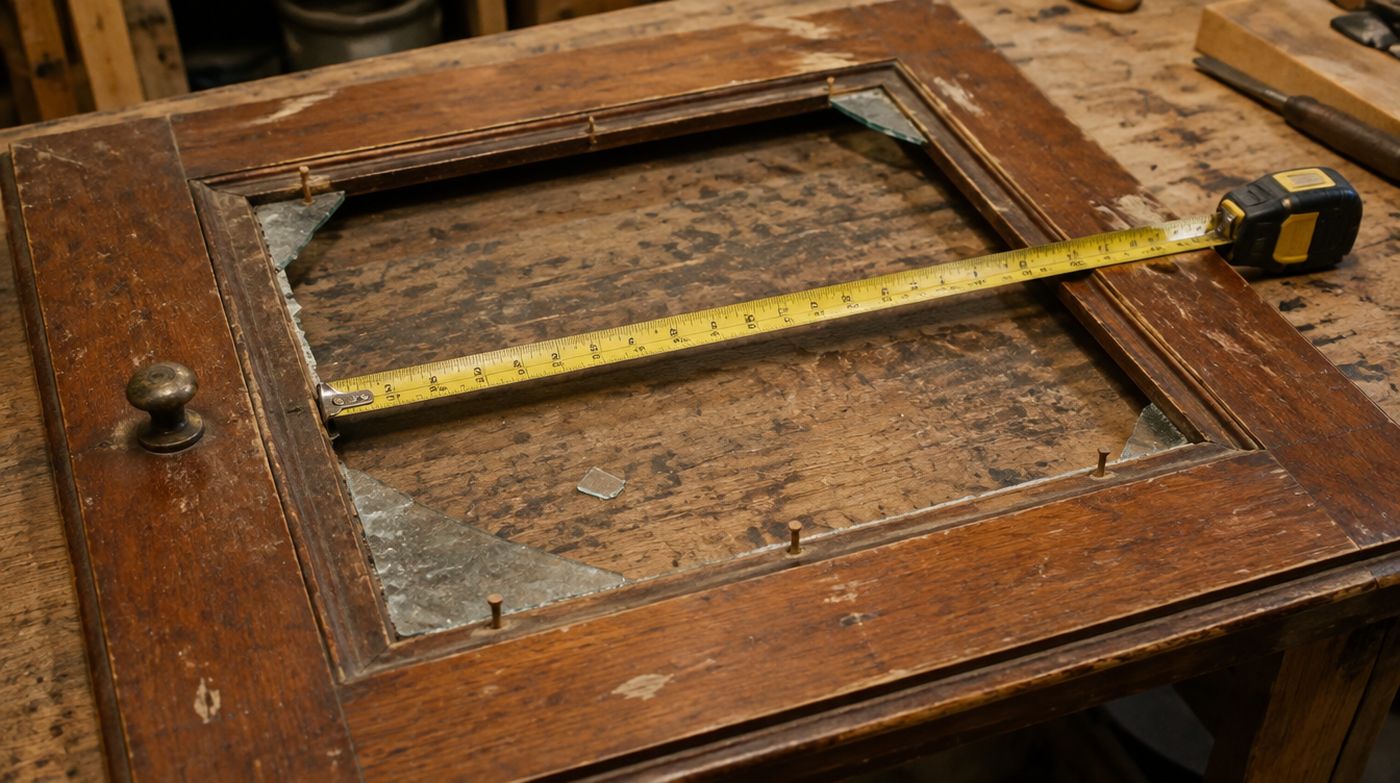
Measuring for replacement glass panels when the old one is broken
The instinct is to measure the broken pane. Resist it. Fragments do not reassemble accurately, the edges may have been nibbled during removal, and in any case the pane that broke may not have been the right size in the first place. For replacement glass panels, measure the frame.
Take the aperture: the clear opening the glass has to sit in, measured at the back of the rebate or between the beads, not across the visible face of the glass. Measure it in at least three places across the width and three up the height, because old frames are rarely consistent, and work from the smallest figure in each direction. Then take both diagonals. If they differ by more than a few millimetres, say so when you order, because a square pane going into a parallelogram needs more clearance than the usual deduction.
Then deduct a clearance. For a small pane in a timber or metal rebate, two millimetres off each dimension is typical, so the pane is 2mm narrower and 2mm shorter than the opening. That gap lets the frame move with temperature and humidity and gives the putty or sealant something to grip. A pane cut hard to the aperture will bind as soon as the timber swells, and a bound pane is a cracked pane.
Tell us clearly whether the figures you send are the aperture or the finished glass. That is the single most frequent cause of a replacement pane arriving the wrong size, and it is not usually the cutter’s error.
Working out what the original glass was
Three things to establish: thickness, type and whether it was a safety glass. The thickness you can take off a surviving fragment with a tape or a vernier, or off the depth of the rebate and the amount of putty, though that second method is approximate. Common thicknesses in older domestic work are 3mm and 4mm for small panes, 4mm and 6mm for larger ones, and 6mm upward for anything substantial.
Type is usually obvious once you look at a fragment edge-on. Clear float has a faint green cast along the edge. Low-iron is noticeably clearer there. Laminated shows a thin dark line through the middle of the edge where the interlayer sits, and a laminated pane that has broken will be held together rather than fallen out. Mirror has a silvered back and a protective paint coat.
The important one is whether the original was toughened. Look for a permanent sandblasted or acid-etched mark in one corner, usually a few millimetres high, carrying a standard number such as BS EN 12150 and a maker’s identifier. If a fragment carries that mark, the pane was toughened, and the replacement must be toughened too. If the pane shattered into a pile of small blunt chunks rather than long shards, that is also your answer. In a door, a door side panel or a low window, that distinction is not cosmetic. Those are critical locations under Approved Document K and the replacement has to be safety glass to BS 6206 Class A or the modern equivalent, whether the original was or not.
If the pane you are replacing sits in or beside a door, or close to the floor, assume it needs to be safety glass until someone shows you otherwise.
Patterned and obscure glass: matching an old panel
This is where most replacement jobs become difficult, because patterned glass has been made in hundreds of designs over a century and many of them are long out of production. A handful of patterns are still rolled today and are easy to supply. Many Victorian, Edwardian and mid-century patterns are not made at all any more.
So before you plan around a match, send us a photograph of the pattern with a tape measure or a coin in the shot for scale, and a note of where the pane sits. We will tell you honestly whether it is a current pattern, a close relation, or gone. If it is gone, you have three options, and the right one depends on the room rather than on the glass.
Replace the single pane with the nearest current pattern and accept that it does not match. Replace all the panes in that door or window with one current pattern so at least the set is consistent, which usually looks better than one odd pane among five. Or replace with a plain obscure such as a sandblasted or acid-etched finish, which reads as a deliberate choice rather than a failed match. For a front door with a leaded or stained panel, there is a fourth route: a specialist can often repair or remake the panel using salvaged glass, and that is a job for a stained glass restorer rather than a glass cutter. We will tell you when that is what you need instead of selling you a panel.
Clearance, rebates and bead depth
Check how much of the pane edge the frame actually covers before you order. In a timber rebate you want enough cover that the edge of the glass is concealed and supported, and if the rebate is shallow because somebody planed it out, a thicker pane may not seat. In a beaded frame, the bead depth sets both the maximum thickness and the clearance you can get away with.
If you are stepping up a thickness, from 3mm to 4mm for instance, make sure the rebate or bead can take it. A pane that is 1mm too thick for the rebate will either not let the bead close or will sit forward and get pinched when it is pinned. That is the second most common cause of a new pane cracking within a month, after being cut too tight.
Old putty needs to come out entirely, and the rebate needs to be cleaned back to sound timber and primed before new putty goes in. That is a dull job and it is the one people skip. A new pane bedded onto crumbling old putty and painted over will leak and will be loose inside two winters.
Furniture, cabinets and display units
Cabinet and furniture panes are usually simple to replace and are the jobs where we most often tell people to spend less. A pane in a bookcase door, a sideboard, a display cabinet or a clock face is fully framed, cannot be fallen through and carries no load. Plain annealed float at the original thickness is the correct answer, and paying for toughening there is paying for nothing.
Watch for two things. Many antique and mid-century cabinets used 2mm or 3mm glass, which is thinner than anything in modern building use, and fitting 4mm will stop a rebated door closing. And glass in a curved cabinet door is bent glass, which cannot be cut from flat stock at all and needs a specialist former.
Doors, door side panels and low windows
Door glass is the one category where the rules take over from preference. Glazing in a door, in a side panel next to a door, and in any window with glass close to floor level sits in what the building regulations call a critical location. Replacement glass there must be safety glass, properly marked, in a size that triggers the requirement.
So a plain float replacement in an internal door is not a saving, it is a defect, and if you sell the house a surveyor may well pick it up. Toughened is the usual answer and is cheaper than laminated. Laminated is the better answer where the pane also has a security or an overhead function, since it holds together in the frame when broken. The site covers the toughened and laminated comparison in detail elsewhere, so we will leave it at that here.
For a double glazed door or window panel, you are not replacing a pane at all, you are replacing a sealed unit, and that is a different product with different measurements and a different lead time.
Picture frames, greenhouses and sheds
Picture frame glass is 2mm clear float, and for most purposes that is all it needs to be. If the picture is valuable or sits in sunlight, a UV filtering or non-reflective glass is worth the money, but for a poster in a hallway it absolutely is not, and the premium is substantial. Measure the frame rebate, deduct a millimetre each way, and that is the whole specification.
Greenhouse panes are usually 3mm horticultural float in a small number of standard sizes, and if one has gone it is worth ordering two or three spares at the same time, because the next one will go in the next gale and the cutting setup is already paid for. Shed and outbuilding windows take 4mm float, or toughened if the window is somewhere children play.
When a replacement panel is not worth it
Be realistic about the frame. If a timber sash or casement is soft, the joints have opened and the rebate is rotten, a new pane bedded into it is money spent on a frame that is failing. Repair or replace the frame first, or accept that the glazing will be temporary.
The same goes for a rusted steel window where the frame has expanded and cracked the pane. New glass in that frame will crack again, because the cause has not been dealt with. And if a single pane in a run of six patterned panes is going to look obviously wrong, price up doing all six before you commit to the one, because the difference is often smaller than you expect and the result is far better.
FAQ
Questions about replacement glass panels
How do I measure for a replacement glass panel?
Measure the frame, not the broken glass. Take the clear aperture at the back of the rebate or between the beads, in three places across the width and three up the height, and use the smallest figure in each direction. Check both diagonals too, because a frame that is out of square needs more clearance. Then deduct a clearance, commonly around two millimetres off each dimension for a small pane in a timber or metal rebate, so the frame can move and the putty or sealant can grip. Always state whether the figures you supply are the aperture or the finished glass size.
How can I tell if my old glass was toughened?
Look for a permanent etched or sandblasted mark in one corner of a surviving fragment, a few millimetres high, usually naming a standard such as BS EN 12150 along with a manufacturer’s identifier. The way it broke is the other clue: toughened glass collapses into a heap of small blunt pieces, while annealed glass breaks into long sharp shards that often stay partly in the frame. If the pane was in a door, beside a door or low in a window, it should have been safety glass regardless of what was actually fitted, and the replacement must be.
Can you match old patterned glass?
Sometimes. A few patterns are still rolled today and can be matched exactly. Many Victorian, Edwardian and mid-century designs are out of production and cannot be matched from new stock at all. Send a photograph with something in shot for scale and we will tell you which case you are in rather than guess. If the pattern has gone, replacing every pane in that door or window with one current pattern usually looks far better than one mismatched pane in a set, and a plain acid-etched or sandblasted obscure reads as a deliberate choice. Leaded and stained panels are a restoration job rather than a cutting job.
Send us your sizes
Give us the glass type, thickness and sizes in millimetres, or a cutting list. We will come back with a price and a lead time.