Bespoke glass cut to size: templates, shapes and awkward openings
Bespoke glass cut to size means anything that is not a plain rectangle. This page is about how a shaped panel is actually produced, what we need from you to produce it, and the jobs where a shaped panel is the wrong answer.
When glass actually needs to be bespoke, and when it doesn’t
Bespoke glass cut to size covers curved edges, raked tops, tapered panels, circles, scribed panels that follow an uneven wall, and anything shaped around an obstruction. It is slower, it needs a shaping machine rather than a cutting bench, and it is priced accordingly. Before you commit to it, be honest about whether the shape is doing any work.
A surprising number of enquiries for shaped glass are solvable with a rectangle. An alcove that is 6mm wider at the top than the bottom does not need a tapered shelf, it needs a rectangle cut to the narrow dimension and two small shadow gaps nobody will ever notice. A splashback behind a run of worktop meeting a wall that bows does not need scribing, it needs a rectangle and a neat bead of neutral cure silicone. A table top that has to clear a curved sofa does not need a kidney shape, it usually needs to be 50mm smaller.
So the test is simple. If a rectangle leaves a gap you can close with a trim, a bead, or by accepting a slightly smaller panel, order the rectangle. If a rectangle leaves the glass visibly wrong, fouling something, or short of a surface that has to be covered, then it is a genuinely bespoke job and the rest of this page applies.
What a usable template looks like
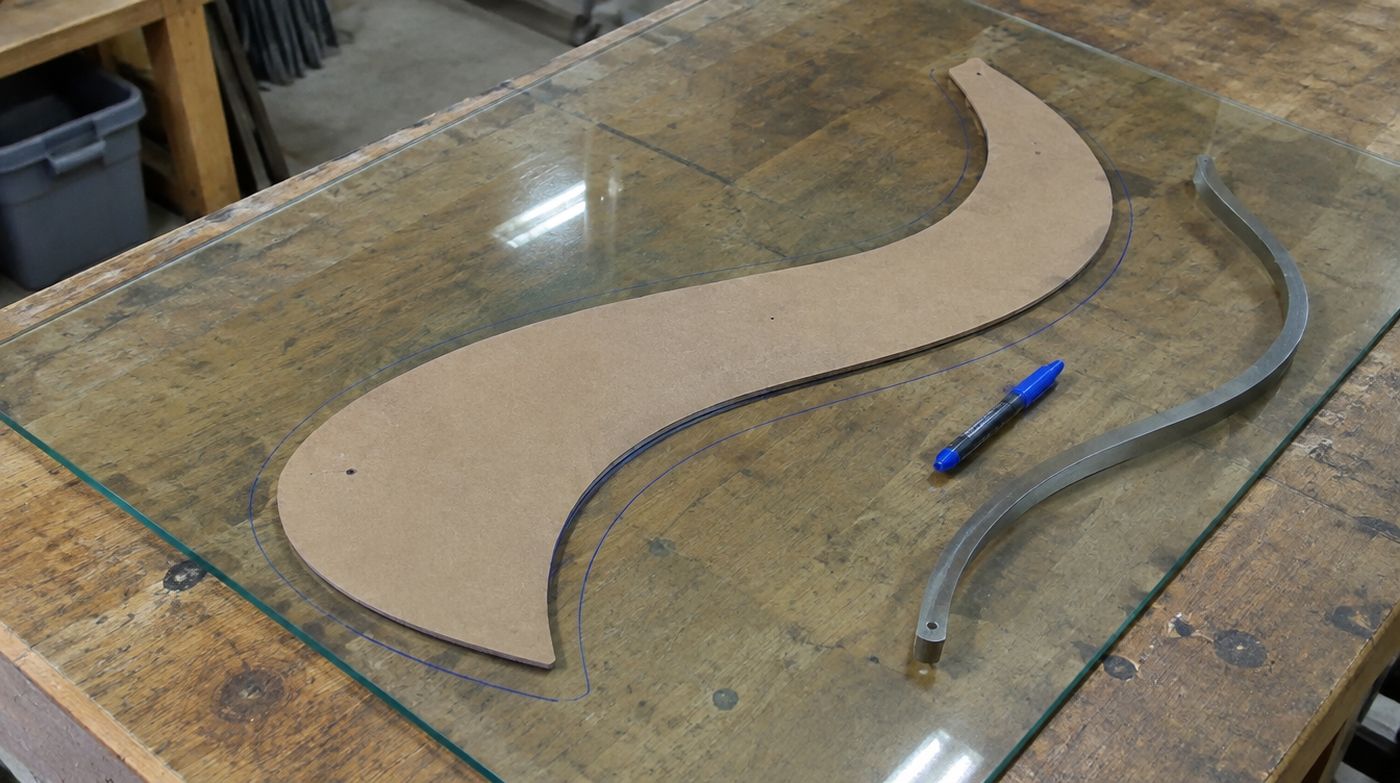
A template is a full size physical pattern of the finished panel. It is not a sketch and it is not a set of dimensions with a note saying curved. Once we have it, the panel can be cut from it with real confidence, because the template is the panel. Everything in the workshop references it, including the shaping and the final check before the piece is polished or sent to the furnace.
It needs to be rigid enough to handle without distorting, and it needs to be exactly the size you want the glass to be, not the size of the hole. That second point is the one people get wrong. Make the template to the finished glass, with your clearances already taken off, and write on it in large letters that it is the finished size. If you would rather we took the clearance off, write that on it instead, and say what the panel is fitting into so we know how much to take.
Hardboard, 3mm or 4mm MDF, thin plywood and stiff corrugated card all work. Thin card that flops is useless, and so is paper. We can work from a template made in several pieces taped together if the shape is large, so long as the joints are solid and nothing can hinge.
Making a template: marking, the datum and the face
Cut the template oversize, offer it into position, and scribe it down in small bites until it drops in where the glass has to sit. That is the whole method, and it is more accurate than any amount of measuring, because it is a physical test rather than an arithmetic one.
Then mark three things on it before it leaves your hands. First, which way up and which face is which, written on the side that will be visible. A shape that is not symmetrical can be made perfectly and still arrive as a mirror image of what you wanted, and that is a bad conversation for everyone. Second, a datum: a straight reference edge, even a pencil line, so the shaping machine has something true to work from. Third, every position where the panel meets something fixed, so we know which edges are critical and which have slack.
If the shape includes holes or cut-outs, drill or cut them in the template rather than dimensioning them. The site covers holes, notches and cut-outs in detail elsewhere, so here it is enough to say this: a marked template removes the risk of a hole being 8mm out, and 8mm out means the panel is scrap if it has been toughened.
The template is the only drawing that cannot be misread. Make it carefully, label it clearly, and the panel will fit.
Curves, radii and the limits of a shaped edge
A curved edge is ground, not scored. The outline is roughly cut, then taken back to the line on a shaping machine, then arrised or polished. Convex curves are easier than concave ones, and the tighter a concave curve gets, the more limited the tooling becomes. There is a practical floor on internal radius, and it depends on thickness: thicker glass needs a more generous radius because the wheel has more material to remove and more heat to shed.
So if you have drawn a shape with a tight internal notch, expect the finished glass to have a slightly larger radius in that corner than your drawing shows. Tell us if that corner is critical because something has to pass through it, and we will tell you the smallest radius we can actually hold rather than agreeing to a figure and disappointing you later.
Worth separating two things people conflate. A curved cut means the outline of a flat panel is curved. Curved glass means the panel itself is bent, which is a separate manufacturing process involving a mould and a kiln, with long lead times and real cost. If you need a bent panel for a curved balustrade or a curved shopfront, that is a different order and a different conversation. Most enquiries that say curved glass mean a flat panel with a curved edge.
Angled, raked and tapered panels
Raked panels come up constantly in London loft conversions and under staircases. A screen following a roof pitch, a shelf under a sloping ceiling, a splashback where the wall kicks back. These are straightforward to cut, because they are straight lines, but they are easy to get wrong on paper because a single wrong angle throws both long edges.
Do not send us an angle in degrees if you can avoid it. Send us a template, or send us the three or four corner-to-corner dimensions that define the shape. Dimensions can be checked against each other. A quoted angle cannot, and a degree out over 1.8 metres is 30mm at the far end.
For a tapered panel, give us the width at both ends and the length, and tell us which end is which relative to the room. For anything with more than one angle, a template is not a luxury, it is the only sensible way to proceed.
Circles, ellipses and arcs
Circles are cut on a circle cutter and then edged, and they are one of the few shapes where a dimension beats a template: give us a diameter and we will give you a true circle. Ellipses are different. An ellipse is defined by two axes and there is only one ellipse for any pair, so those two figures are enough, but people frequently mean an oval that is not a true ellipse, in which case we are back to a template.
An arc on one edge of an otherwise rectangular panel, which is the commonest bespoke request we get for table tops and shelves, needs either a radius and a centre point, or a template. If you can give the radius, give the radius. It is quicker and it gives a mathematically fair curve, which a hand-drawn template never quite does.
Who carries the risk when a shaped panel is wrong
This matters more on bespoke work than on anything else, because a shaped piece has no resale value and cannot be trimmed into something else. If we cut from your template and the panel matches your template, the panel is right, even if the template was wrong. If we cut from your dimensions and the panel matches your dimensions, the same applies. If we surveyed and templated the job ourselves, the risk is ours and we remake it.
That is not a company policy invented to be awkward, it is simply where the information came from. It does mean you should think about which route you want. For a complicated shape in toughened glass, paying for a site visit and a template taken by the person who will process the panel is often cheaper than the risk you are carrying by doing it yourself. For a simple raked shelf, it almost never is.
Where bespoke glass cut to size is worth paying for
It is worth it where the shape is load bearing on the design: a worktop upstand following a chimney breast, a shelf scribed into a Victorian alcove where the plaster is 15mm out of plumb, a shower screen panel raked to a loft ceiling, a table top shaped to a bay window. In those positions the gap a rectangle would leave is the thing you would look at every day.
It is not worth it where the shaped edge will be hidden, where the gap would be under 5mm, or where the shape exists only because a rectangle felt unimaginative. We would rather talk you down to a rectangle and keep the work than take the order and have you wonder later what you paid the extra for. If you send us a template and we think a straight cut will look the same, we will say so before we start.
One last piece of honesty about money. Bespoke work is priced on the shaping time and the risk, not on the area of the glass. So a panel with one gentle curve costs far less than a panel of the same size with four scribed edges and two cut-outs, and simplifying a shape by one element often takes a real amount off the price. Ask what the expensive part of your shape is. We will tell you, and you can decide whether you want it.
FAQ
Questions about bespoke glass cut to size
Do I need a template for bespoke glass cut to size?
You need one for anything you cannot fully define with dimensions. Curves without a stated radius, scribed edges following an uneven wall, multiple angles and irregular outlines all need a full size physical pattern. You do not need one for a rectangle, a circle given as a diameter, a true ellipse given as two axes, or a simple taper where you can give the width at both ends and the length. If in doubt, make the template. It is the one drawing that cannot be misread, and on toughened glass it removes the risk of a panel that cannot be adjusted.
What should I make a glass template out of?
Something rigid that will not distort while it is handled: 3mm or 4mm hardboard, thin MDF, thin plywood, or stiff corrugated card for smaller shapes. Avoid paper and avoid flimsy card. Cut it oversize, offer it into position, and scribe it back in small stages until it sits exactly where the glass has to sit. Make it to the finished glass size with your clearances already deducted, and write on it that it is the finished size. Mark which face is which, mark a straight reference edge, and cut any holes into the template rather than dimensioning them.
Can you cut glass to a curve or a radius corner?
Yes. Curved outlines are roughly cut and then ground back to the line on a shaping machine before being arrised or polished. Convex curves are simpler than concave ones, and there is a minimum internal radius that depends on the thickness, because thicker glass needs a more generous curve for the tooling to follow. Give us a radius and a centre point where you can, since that produces a fair curve, or a template where you cannot. Note that a curved outline on a flat panel is a different thing from bent glass, which is formed over a mould in a kiln and is a separate process.
Send us your sizes
Give us the glass type, thickness and sizes in millimetres, or a cutting list. We will come back with a price and a lead time.