Glass cutters near me: what to expect, and what to send them
If you have searched for glass cutters near me, you want someone who can take a size and hand you a finished pane. Here is what that transaction should look like, and how to describe your job so the price you are quoted is the price you pay.
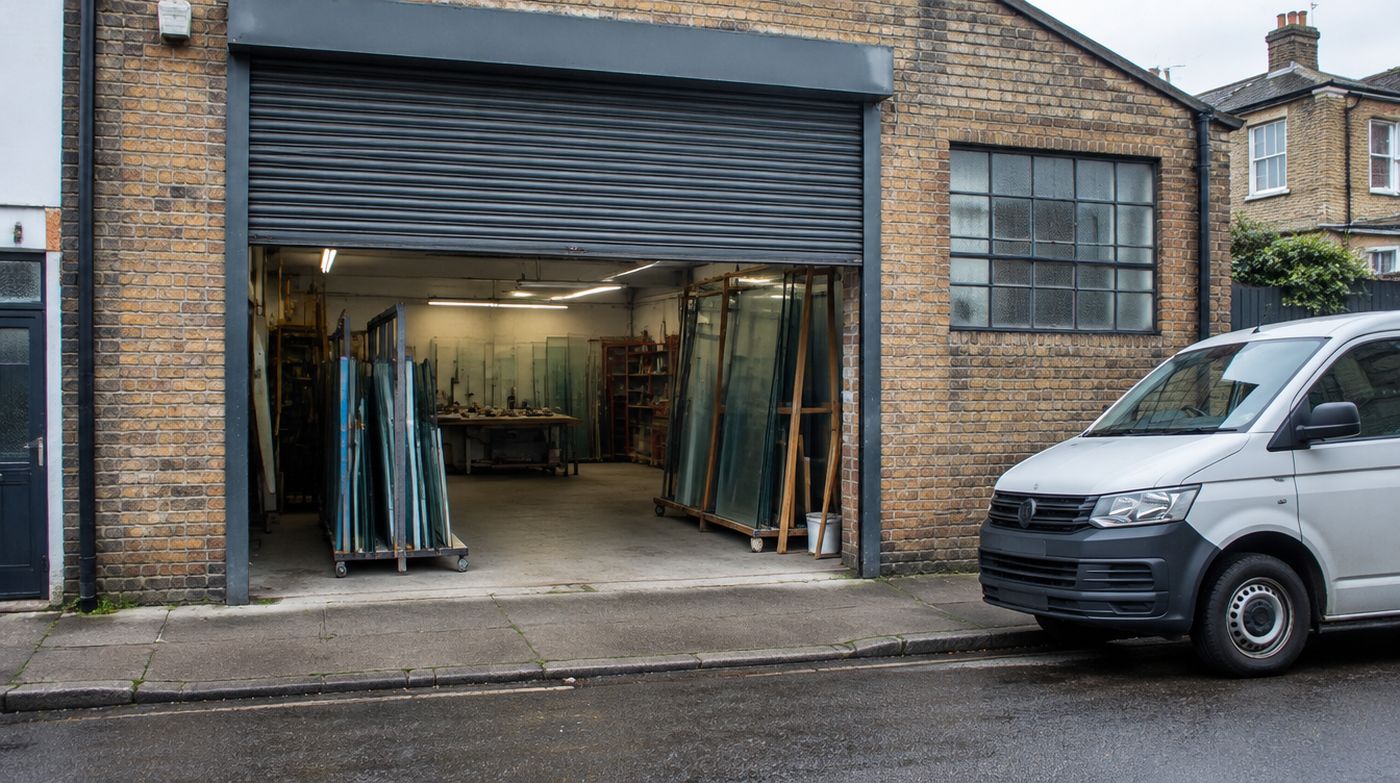
What searching for glass cutters near me should actually get you
When people type glass cutters near me into a phone they are usually standing next to a broken pane or an empty frame, and they want three things: someone who will answer, someone who can cut the glass rather than order it in, and a price today. Those three together are rarer than the search results suggest, because a lot of what comes back is either a glazing company that subcontracts the cutting or a builders’ merchant that sends your sizes to a processor.
Neither of those is dishonest, and for some jobs it makes no difference to you at all. It matters when you want it quickly, when the job is unusual, or when you need to ask a technical question and get an answer from the person holding the cutter. Our workshop is on Atlas Road in Wembley, HA9, and the cutting, edging, drilling, toughening and laminating happen in that building. If you ring during the day you are speaking to people who can walk over and look at the sheet.
Glazier, glass cutter, processor: who does what
These words get used interchangeably and they mean different things, which is worth understanding before you ring anyone.
A glazier fits glass. They come to the property, take out the broken pane, bed in the new one and make good. They may or may not cut their own. A glass cutter or processor makes the pane: cutting, edging, drilling, toughening, laminating, mirroring. A glass merchant sells glass and may do some light cutting over the counter, though the heavier processing usually goes out. A double glazing company sells and fits windows and buys everything in.
If you have a broken pane in a window and no desire to touch it yourself, you want a glazier. If you have a frame, a shelf bracket or a table base and a tape measure, you want a cutter, and you will pay less because you are doing the fitting. We do both, and we will tell you which one your job actually needs when you describe it. Sometimes the honest answer is that a local handyman with a tube of putty will do the job for a fraction of what a glazing company would charge to attend.
How to describe a job so the quote is right first time
Most of the back and forth on a cutting enquiry comes from missing information rather than difficult requirements. Six things settle almost every job, and if you include them in the first message you will usually get a firm price back rather than a question.
What the glass is for and where it goes. A shelf, a table top, a door pane, a splashback, a cabinet front. That one phrase tells us the likely thickness, whether it needs to be safety glass, and what edge finish makes sense. Then the sizes in millimetres, width first and height second, and a clear statement of whether those are the aperture or the finished glass. Then the thickness, if you know it, or the thickness of the old pane. Then the type: clear, low-iron, obscure, mirror, toughened, laminated. Then what you want done to the edges and whether there are holes, notches or radius corners. Then whether you are collecting from Wembley or want it delivered, and roughly where in London.
Give us those and you get a price. Leave out the position and the thickness and you get a conversation, which is fine but slower.
What to send by email, and what to bring
Photographs do more work than descriptions. A picture of the frame or the location, a picture of the broken pane in place if it is still there, and a close-up of any pattern with a tape or a coin in shot for scale. If there is an etched mark in a corner, photograph that too, because it tells us exactly what the original glass was.
A sketch beats prose for anything with more than four edges. It does not need to be neat or to scale, but every dimension should be written on it, and it should be obvious which way up it goes. If the shape is genuinely irregular or follows an uneven wall, you want a physical template, and our bespoke glass cut to size page explains how to make one properly.
Do not bring the broken glass in to be measured. It will not reassemble to the right size, the edges will be damaged and we cannot do anything with it. Bring a photograph and the figures off the frame instead. One exception: if you have an intact pane and want an identical copy, bringing the original is genuinely useful, because we can measure it, read the mark on it and match the pattern against what is on the floor.
Collecting from the workshop
Collection is the cheapest route and for small panes it is easy. The workshop is open Monday to Friday, 8am to 5pm. Ring before you set off, because an order that is ready and an order that is on the bench feel very different when you have driven across London.
Bring something to transport it in. Glass travels standing on its edge, leaning slightly back against a padded surface, never flat on a seat or in a footwell where a corner can take a point load over a bump. A blanket, an old duvet or a few lengths of cardboard between panes is enough for anything small. A large panel wants two people and a van, and if your panel is over about 1.5 metres in either direction, think seriously about letting us deliver it instead.
If you are coming by public transport for a picture frame pane or a small shelf, say so when you order and we will wrap it so it can be carried safely. There is no charge for that, and nobody should let you leave with bare glass under your arm.
Delivery across London
We deliver across Greater London, and we are strongest and quickest in the north, west and central boroughs because that is where most of our work sits. Wembley to Kensington, Camden, Islington, Ealing or Barnet is a straightforward run. South and far east London we also cover, just with a little less flexibility on the day.
Two things make a delivery go smoothly and they are both about your end. Tell us the access honestly: which floor, whether there is a lift, whether the stairs have a tight half landing, whether there is anywhere to stop. A 10mm toughened panel that cannot get round the turn in a Victorian staircase is a problem that has to be solved before it is made, not on the doorstep. And check the parking. Permit zones, red routes and controlled bays across central and inner London all affect whether a vehicle can stand long enough to unload safely, and glass is not something to rush.
If it is a single small pane, do not pay for delivery. Collect it, or let us wrap it for the train. Paying a delivery charge to receive a 400mm by 300mm pane of 4mm float is money for nothing, and we would rather tell you that than take it.
Questions worth asking before you pay
Ask whether the glass is cut on site or ordered in, because that determines whether a question gets answered or relayed. Ask what the lead time is for your specific job, since a plain float cut and a toughened panel with polished edges are not remotely the same wait. Ask whether the price includes edgework, because an arrised edge and a flat polished edge are different jobs and an unspecified quote often assumes the cheaper one.
Ask what tolerance they work to and whether the clearance is being deducted by them or by you. And ask what happens if it does not fit. The answer should distinguish between figures you supplied and figures they surveyed, and anyone who is vague about that distinction is being vague deliberately.
When the nearest glass cutter is not the right choice
Proximity is worth a lot when you are collecting a pane the same day. It is worth very little otherwise, and there are jobs where the closest cutter is the wrong call. If your job needs toughening, laminating or mirroring, a cutter who sends that work out is adding a week to your lead time no matter how close they are. If you need a shape templated and processed, you want the templating and the machining under one roof. If you need a sealed unit, you need a unit maker.
And if the job is one pane of 3mm float for a greenhouse, the nearest cutter is exactly right and we would say take it. There is nothing we can do to a small annealed pane that is worth a trip to Wembley for. Use whoever is round the corner, and keep us for the work where the processing actually matters.
FAQ
Questions about glass cutters near me
What do I need to tell a glass cutter to get a price?
Six things settle nearly every job. What the glass is for and where it goes, since that determines thickness and whether safety glass is required. The sizes in millimetres, width first and height second, with a clear note of whether they are the aperture or the finished glass. The thickness, or the thickness of the pane you are replacing. The type, meaning clear, low-iron, obscure, mirror, toughened or laminated. What you want on the edges, and any holes, notches or radius corners. And whether you are collecting or want it delivered, and roughly where in London you are.
Can I carry cut glass in my car?
Small panes, yes, if you transport them properly. Stand the glass on its edge, leaning slightly back against a padded surface such as a folded blanket, and make sure nothing can slide or tip. Never lay a pane flat on a seat or in a footwell, where one corner takes a point load over every bump and the pane cracks from that corner. Put cardboard between separate panes. Anything over about 1.5 metres in either direction needs two people and a van rather than a car, and at that size a delivery is usually the sensible choice.
Should I use a glazier or a glass cutter?
A glazier comes to the property and fits the glass, removing the old pane and making good afterwards. A glass cutter supplies the finished pane and you or your builder fit it. If you have a frame, a bracket or a table base and you are comfortable with a tape measure and some putty or beads, use a cutter and you will pay noticeably less. If the pane is high up, in a sash window, part of a sealed unit, or somewhere you would rather not be handling glass, use a glazier. Describe the job and a decent firm will tell you which one you need.
Send us your sizes
Give us the glass type, thickness and sizes in millimetres, or a cutting list. We will come back with a price and a lead time.